
Leveraging AI and Digital Health Passports for 248 Million Children
In my work across school-based child health programs in India, one thing has become hard to ignore: our health system sees most children only when they fall visibly ill. For a population of 248 million children, that is a structural problem, not a parenting problem.
A school-based model, backed by Digital Health Passports and AI as a co-pilot, is helping shift child health care from reactive to preventive infrastructure. In this article, I share where technology is working, where it falls short, and how this model is building toward the vision of “Healthy Kids, Healthy Nation.”
The constraint: reactive child healthcare at the population scale
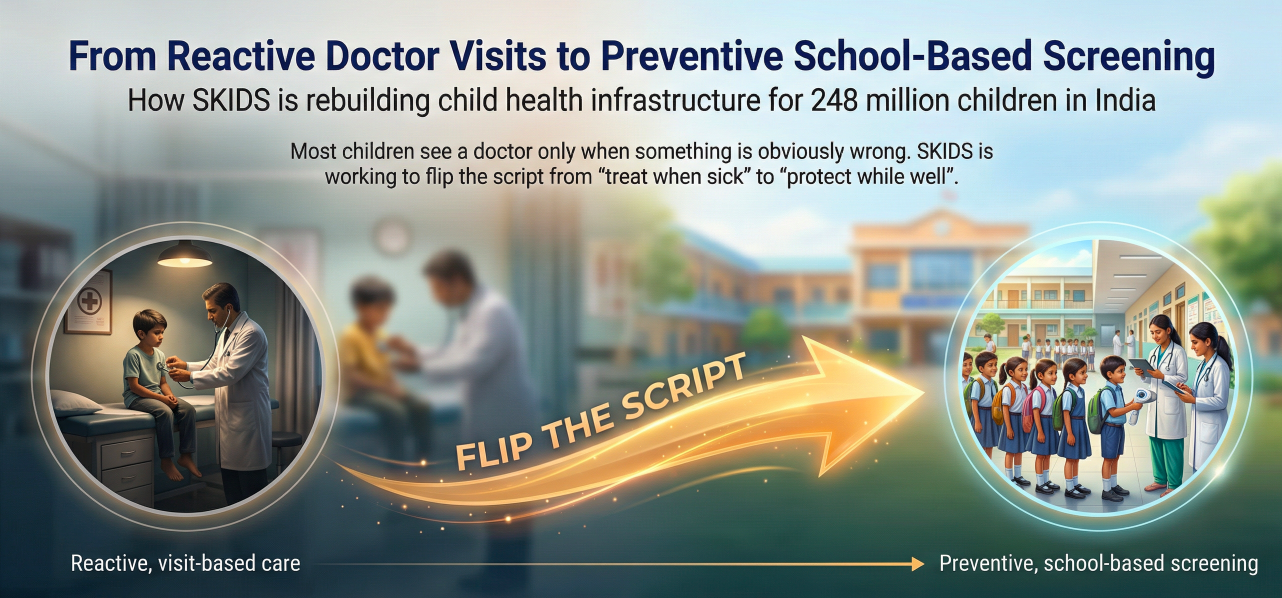
In India, most parents take their children to a doctor only after something is obviously wrong. Our health infrastructure is still designed to respond to problems once they surface, rather than to identify risks early and prevent them from becoming bigger issues and incurring higher costs. India has 248 million children aged 3 to 18. In principle, all of them can benefit from preventive care. In practice, most don’t. That is the constraint I see every day. So the focus has to shift to pediatric preventive health at scale, moving from “treat when sick” to “protect while well.”
What makes this shift viable now is AI moving from a research topic to an effective tool that can support advanced workflows. It enables an end-to-end pediatric screening model, from identification and screening through follow-up and escalation. Schools can become primary health hubs, enabled by AI and digital records. This school-led strategy delivers an affordable, repeatable, and executable operating system for child health delivery, adaptable from metros to remote blocks. The next breakthrough will be converting 1.5 million schools in India into localised Primary Health Hubs.
Digital Health Passport and AI as a co-pilot
The foundation of this approach is the Digital Health Passport (DHP), a digital solution for child health records and preventive screening. It functions as a longitudinal Electronic Health Record (EHR) that tracks a child’s health metrics consistently from Grade 1 through Grade 12. The DHP helps ensure critical health data isn’t lost between check-ups, which is what makes continuity possible.
Every child we screen gets a DHP. This matters because children change quickly. Normal vision today is not a guarantee of normal vision two years later. Without continuity, every visit becomes a fresh check, with no prior data to compare against. The DHP makes trends visible. It helps us spot when a parameter drifts, and sometimes when early signals suggest something may go wrong. That allows earlier nudges to parents and schools, when intervention is simpler, and outcomes tend to be better. AI sits on top of this data layer. It helps teams work with volumes that would otherwise be overwhelming.
In government programs, I’ve seen how quickly insights get lost when they are trapped inside spreadsheets and static reports. With an AI layer, patterns at the block or district level become easier to surface, and it becomes easier to prioritise which cases need follow-up and which ones need escalation. Over time, this also helps predict and prioritise emerging risks, so that limited specialist time is first allocated to the children and geographies where the risk is highest.
This changes the economics of pediatric care as well. One pediatrician can guide work across many schools. Field staff can focus on execution and follow-ups. Specialists spend more time on complex cases and less on routine screening.
Reaching children in public and private schools
I and my team at SKID are intentional about reaching the two large segments of India’s school-going population. On one side are 136.4 million children in public schools, often reached through government programmes. This is vital to reach underserved and vulnerable communities with structured preventive care. On the other side are 111.6 million children in private schools, reached through schools and parents.
The goal is to reach all 248 million children and identify common, treatable issues through school-based screening, including anaemia, dental caries, and uncorrected vision. If these are not addressed, they quietly erode learning and attention, changing both individual progress and school outcomes. In our work, and in wider health datasets, we see how widespread this hidden burden can be: anaemia is prevalent across many age groups, dental caries are common, and vision issues show up earlier than many families expect.
Where do the gaps remain?
Technology helps standardise screening and follow-up. It reduces human error at scale. It provides visibility into who has been screened, what was found, and what happened next. AI helps focus scarce human time. It helps teams ask better questions of the data, and it gives decision-makers a live view of risk across schools and geographies.
But technology cannot complete the last mile on its own. AI cannot get a child to wear glasses. It cannot convince a parent to treat anemia early. Those steps require trust, human follow-through, and simple, actionable communication.
One of the most effective bridges I’ve seen is parent communication that is easy to understand and easy to act on. Clear reports, in simple language, with upcoming procedures documented, make a measurable difference in turning screening into outcomes.
Why this matters economically and socially
Through our interventions, each 1 rupee invested in preventive screening has generated roughly 13 rupees of social and economic value. Early identification reduces expensive downstream treatment. In some cohorts, we have seen up to an 80 per cent reduction in avoidable hospitalisations when problems are detected and promptly followed up. Healthier children attend school more consistently and learn better. Preventing avoidable disability also has intergenerational effects on income and opportunity, strengthening human capital and long-term economic growth.
If you are a fellow founder building at the intersection of an industry and technology, my suggestion is simple: start with the constraint, not the technology. At SKID, the constraint for my team was a system built around reactive child healthcare. Everything flows from that: schools as primary health hubs, Digital Health Passports as the backbone, and AI in the background helping deliver preventive care.
AI alone cannot solve India’s child healthcare challenge, but when combined with school-based screening and digital health tools, it can help shift child health care from reactive to preventive, moving closer to “Healthy Kids, Healthy Nation.”