
The Aspirational Talent Imperative for CXOs
If you and I were sitting across a table discussing growth strategy, you might say: "We need more innovation. More agility. More people who think differently.”
And then, in the very next hiring meeting, someone asks: "Do they fit our culture?”
That one question often carries more weight than the strategy deck. It quietly decides whether you’ll build for the future, or preserve the past.
SHIFT: FROM STABILITY TO VOLATILITY
Across markets, from India’s digital acceleration to Brazil’s industrial reinvention and Europe’s energy transition, the competitive environment is no longer linear. Technology cycles are shrinking. Customer expectations are rising. Business models are evolving in real time.
Consider what has happened in the last decade alone. Traditional retail has been disrupted by digital-native platforms. Automotive companies are becoming software companies. Manufacturing firms are investing more in analytics and automation than in infrastructure expansion.
In those environments, yesterday’s expertise quickly becomes tomorrow’s limitation. Yet our hiring practices often remain rooted in an earlier era, one where predictability mattered more than adaptability.
For decades, “culture fit” felt safe. It minimized friction and fostered cohesion. But in times of uncertainty, cohesion without challenge breeds complacency.
Research supports this. Studies from leading business schools show that cognitively diverse teams solve complex problems faster and generate more creative solutions than homogeneous groups. McKinsey’s global research on diversity has repeatedly demonstrated that companies in the top quartile for diversity outperform peers in profitability. Boston Consulting Group has found that organizations with diverse leadership teams generate significantly higher revenue from innovation.
The shift is: we are no longer competing on efficiency alone. We are competing on adaptability. Adaptability does not come from sameness.
GAP: WHERE TALENT STRATEGY FALLS SHORT
When leaders say “culture fit,” what we often mean is someone we are comfortable with, someone who thinks like us and won’t disrupt the rhythm. It sounds practical. It appears intuitive. It is truly human. But it creates three invisible risks.
First, innovation erosion. Homogeneous teams converge quickly. Consensus feels like progress. But consensus built on shared assumptions rarely produces breakthrough thinking. The 2008 financial crisis exposed how groupthink within highly educated, like-minded leadership teams contributed to systemic blind spots.
Second, talent drain. High-potential individuals who think differently often disengage within environments that subtly reward conformity. Great Place to Work data shows that employees who feel excluded or unheard are significantly more likely to leave within 2 years. Attrition at senior and mid-management levels becomes a silent tax on growth.
Third, strategic blind spots. Rapidly changing industries require multiple cognitive lenses. Kodak’s inability to adapt quickly, despite inventing digital photography, is a classic example of organizational inertia reinforced by internal consensus.
Technology can scale processes. Only diverse thinking can scale intelligence. That is the gap.
NEXT: FROM CULTURE FIT TO CULTURE ADD
The alternative is what I call the Aspirational Talent Imperative: hiring not for who we are, but for who we must become. Instead of asking, “Does this person fit our culture?” ask, “What does this person bring that we are currently missing?”
That question reshapes the conversation.
Hire for aspirational alignment. Evaluate candidates against your future ambition, not your historical comfort zone. If your strategy calls for digital transformation, global expansion, or customer-focused innovation, your hiring must reflect that aspiration. When one global manufacturing company shifted from hiring primarily mechanical engineers to including data scientists and behavioral economists in leadership roles, productivity improved, not because existing employees were incapable, but because new thinking reframed old processes.
Engineer constructive friction. This is not chaos, it is a structured challenge. High-performing boards and executive teams often assign rotating devil’s advocates to stress-test strategic decisions. Documenting minority opinions before final approval prevents premature convergence.
Measure cultural evolution. Most organizations measure alignment. Few measure evolution. Ask whether new ideas come from diverse sources, whether assumptions are regularly challenged, and whether leaders are comfortable being questioned. Organizations that embed dissent as a discipline, rather than suppress it, build resilience. During the pandemic, companies that encouraged cross-functional debate pivoted faster than those waiting for centralized consensus.
Here are two "culture value add" moments from my own leadership journey.
In my previous stint as CHRO of a large manufacturing organisation: a promotion that upgraded the conventional operating system. In one succession discussion, the safe choice was a high-performing insider, strong execution, widely liked, and fully aligned with how things had always been done. We instead promoted a leader based on potential, assessed through a scientifically designed and deployed Growth Centre, which offered a different lens: data-led problem-solving, tougher shop-floor discipline, and the nerve to question long-held assumptions about manning and accountability. The first month felt uncomfortable, more debate, more pushback. By the next quarter, reviews had turned evidence-based, improvement ideas started coming up from the shop floor, and decision speed picked up as problem framing sharpened. That promotion didn't just fill a role; it lifted capability.
A similar story in an Indian-origin Personal Care and Healthcare organisation: a hire that raised learning velocity. For a business-critical role, "industry fit" and "style fit" were tempting shortcuts. We chose a leader who brought fresh consumer insight, a different way of thinking, and the confidence to disagree respectfully in senior forums. The impact wasn't one dramatic initiative. It was a steady stream of better questions: which customer segments were we under-serving, which channels were being under-used, and which assumptions had gone unchallenged for too long. The team's learning velocity went up, and better decisions followed.
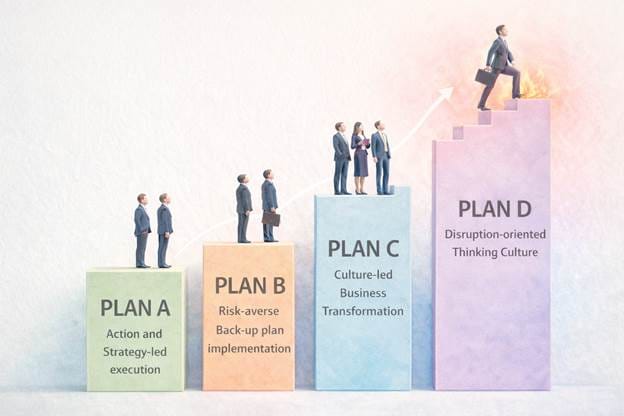
Both instances share the same pattern: short-term discomfort, long-term advantage. In my work with organisations across sectors, I've observed that most businesses operate in one of four modes. Plan A is pure execution, strategy-driven, action-oriented, and focused on delivering what's already been decided. Plan B is defensive, risk-averse, built around protecting existing positions rather than building new ones. Most organisations spend their entire lifecycle cycling between these two, mistaking activity for progress.
What genuinely transforms organisations is the shift to Plan C, Culture-led Business Transformation, where leadership deliberately builds the conditions for different thinking, diverse challenges, and sustained reinvention. When Plan C takes root, it naturally gives rise to Plan D, a Disruption-oriented Thinking Culture, where questioning assumptions isn't a threat to stability but the very engine of it.
The two promotions described above weren't lucky outcomes. They were the result of leaders willing to move past the comfort of Plans A and B and build something harder and more durable. That's the real distinction between a business manager and an authentic leader.
THE LEADERSHIP COURAGE FACTOR
This approach requires significant personal and professional courage and not tentative managerial conditioning. It’s easier to hire people who mirror us than people who stretch us. But markets reward evolution, not nostalgia.
In your next hiring discussion, try this experiment. Instead of debating fit, ask: “If this person rebuilt our culture tomorrow, would we be stronger for the future?” If the answer is yes, you’ve found aspirational talent. The future belongs to organizations brave enough to choose evolution over comfort.