Meta laid off around 8,000 employees and moved 7,000 others into AI-focused roles.
The layoffs got a lot of attention, but I kept thinking about the employees who were reassigned. What are they being asked to do? They are now helping to build systems that could one day decide how much of their own work remains relevant. That is not a small ask. We have seen this kind of workforce shift, often described as an opportunity or a transition.
Lindsay Jessup, CEO of Geeks Ltd, wrote something for us worth reading twice. She said your AI works fine. The real bottleneck is decision-making. Figuring out which problems matter, which tradeoffs to accept, and which direction to take when several options seem equally valid. That is still human work. But it is harder than most organizations have prepared their people for.
Richard Hua, founder & CEO of EPIQ Leadership Group, observed in his article that even skilled teams can struggle with major change, and that the reason is usually cultural. When things feel uncertain, people look to their leaders. If leaders demand speed but react harshly to mistakes, people hesitate. Teams hold back precisely when they need to move.
Both observations point to the same problem. Organizations are asking people to move faster while creating conditions that make movement feel dangerous.
Somayeh Aghnia, co-founder of the London School of Innovation, raised the deeper question. Most organizations think about AI in two stages: what it saves now, and what new value it creates next. But there is a third important stage. When AI can do more of what the organization was built to do, the question shifts from efficiency to purpose. Why does this organization exist?
That question is always present in workforce change.
Most workforce announcements tell you who is staying and who is leaving. Very few tell you what the organization is actually becoming.
If you’re leading through these changes, what are you asking your team to build? And how are you protecting trust as they do it?
What Four Failed Bets Taught Me About Building Something That Lasts
Ashwini Suman | Founder & CEO | Kaara
Read
Ashwini has been running Kaara for long enough to know what a wrong bet feels like. He has made several. He no longer calls them failures.
What he carried out of those years was not a pivot strategy. It was something simpler:stay honest to the basics, follow the business case, and never fall in love with the idea.
The firm today has 220 people. It is growing while TCS and Oracle are cutting. Three months after Kaara.Code went public, JPMC called. He came back from that meeting thinking about a question he had not asked before: how do you give sixty-five thousand engineers the right blueprint and memory for their enterprise development journey? He has a clear position on what is happening in his industry, and it is more contrarian than most people in it are willing to say out loud. This is that conversation.
Kaara has been through significant reinvention. What was the moment you found the clarity that formed what it is today?
We realized the shift in late 2024. The foundational models were getting better, our conversations with customers began to shift, Gen AI adoption took center stage, and soon the conversation moved to Agentic AI use cases and adoption. At the same time, we had started using AI inside our own delivery, in how we write code. There was real internal friction about it, and that friction turned out to be the most useful thing that happened to us.
The more we used AI, the deeper our conviction grew in the importance of context and memory for the proper adoption of Agentic workflows.
That was the moment it dawned upon us: if we wanted to help our customers realize what this shift makes possible, we had to change how we deliver before we asked them to change anything. That’s how the concept of Compounding Build started to take shape.
Before Kaara became what it is today, you tried Social, Edtech, Logistics, and Analytics. What did those experiences teach you about developing something that lasts?
We failed in all of those. None of them became what we hoped. I have moved on, and so has Kaara. We have stopped calling it failure. It was a learning experience, albeit a costly one. Costly enough to be worth remembering. Here is what I took from it.
Never ever fall in love with the idea. Follow the business case: why is it needed, who is going to use it, and how does it make their life better? Ideas are not enough. The discipline of execution, staying close enough to the ground, being able and willing to argue against your own plans, that is what actually matters. Cash flow is one of the most important aspects of any business, and founders often ignore it. The wrong culture can kill great ideas, and no execution SOP can save it.
What I learned is that building something that lasts is actually a lot simpler than most of us think. Today, I try to be honest in what I do, why I do it, who I do it with, and how I do it. Staying honest to the basics is something that I have started to value a lot.
The IT services industry is experiencing its most significant disruption in 30 years. TCS. Oracle. Major cuts. Kaara is still growing. How do you read the current situation?
Our industry is seeing one of the most challenging times in the last 30 years; it was bound to happen sooner or later. AI has not caused it; it just brought it to the surface. This is the unwinding of a pricing model that remained unchanged for 3 decades, the confusion about AI’s value, and enterprises hiding their past decisions in the guise of AI productivity. I am not sure which one is contributing how much. One thing I am 100% certain of is that it’s not machines replacing humans.
It is a mismatch between how the industry has long created value and how value should be created now. We are a small firm, from whichever lens you look at - an IT services company of 220 odd people is a small company, and there are always opportunities for companies our size, no matter the market sentiments. We also made a few bets early, which are paying well. And that’s where the opportunities are: we have to reimagine how we deliver value to our customers, enable our team, and move them up. The days of the business model that assumed scale would always equal growth are long gone, but that’s also where the real opportunities lie.
Kaara.Code was recognized at JPMC's Technology Innovation Forum. What did you learn from that experience?
It has been around three months since we started talking about Kaara. Code and Compounding Build publicly. It was a pleasant surprise to receive a call from JPMC to present under the Modern Engineering Practice track.
The heartening part was understanding what they are doing internally. The context engineering work they are attempting is what Kaara.Code provides systematically. Before meeting them, we didn't realize how important it was to answer the question of scale. JPMC has a tech team of more than sixty-five thousand people. We came back thinking about how we can give each of them the right blueprint and memory for their enterprise development journey. That question changed the size of what we were building.
You have written that people building software matter more in the AI age, not less. That is a contrarian position right now. What gives you the confidence to hold it?
The common assumption is that as AI gets better at writing code, the people who write it matter less. I believe the opposite. My confidence comes from seeing the way Kaara functions today.
It's true that most developers haven't written a single line of code in months. But coding is not the only aspect of building software.
Knowing what is being built, why it is being built, end-user personas, context, compliance, guardrails- all of that has become much more important than before. The role of developers and builders has become more important too, but it moves upstream. It moves to judgment, knowing what to build, which trade-offs to encode, which constraints are real, and what 'done' actually means for a business user.
Furthermore, we are now solving problems that were hitherto unsolvable. The more we build, the more we grow, and the more work there is for everyone. We need to move into this cycle fast.
What is the one thing most companies miss when they move into AI, and why does it keep happening?
Stop inserting AI into old workflows. This is a sheer waste of such a powerful technology, and a lot of us keep taking the easier path.
The easier path is to retrofit AI into existing ways of functioning. What is actually required is to reimagine the work itself from the ground up. The way enterprise services are delivered needs to be completely reimagined. The roles of developers and everyone involved have changed; that does not mean they are going away. It is changing, that is it.
The best part: almost everyone I speak to is realizing this now and ensuring reimagination of workflows in almost every new project implementation.
My simple view is this: The winning companies will be the ones that redesign work, rebuild governance, make AI part of the business's daily operating rhythm, and do it fast.
Electrification is scaling manufacturing fast, but operational excellence still needs a rethink.
The quality engineer spent about 40 seconds at our monitoring screen before he asked his question. He didn't ask about our defect rate. He asked: "What's your process capability on this dimension across all three shifts?"
I knew the average. I didn't know the split by shift.
Over decades of manufacturing, I've sat through more customer audits than I can count at Bosch, Gabriel India, Auto Ignition, and now Endurance. Nobody had ever asked me that. That question was the first clear signal that electrification wasn't just changing the components we make. It was changing the standard by which our manufacturing is judged.
This made me realize that bigger changes were underway in how we are measured. That realization set the stage for everything that followed.
How Electrification Is Changing The Shop Floor Reality
Electrification has changed what good manufacturing means. Electric and hybrid parts need to be made with more accuracy and consistency than most traditional car parts. At Endurance, where we make brakes and suspension for companies building electric vehicles, we've had to rethink what "ready for production" means. There is less room for error, and we must be able to track every part.
The technology response was predictable and, generally speaking, correct. In-line quality monitoring, real-time process dashboards, and predictive maintenance have moved from pilot projects to core capabilities. Manufacturing systems are becoming more digitally connected, sensors and machine data allowing faster detection of variation, shifting teams from reactive problem-solving to preventive and predictive control. Plants are being redesigned with more flexible layouts, a higher automation density, and built-in traceability.
I didn't expect that being good for the environment would become so important for how well we run. Watching our energy use, using materials wisely, and making less waste are now key to staying competitive. These things are not just for CSR reports; they are part of how we work in every electric vehicle project.
The scale of this shift is visible across global manufacturing. From hubs in India to plants in Eastern Europe and Latin America, electric mobility programs are compressing development cycles, increasing quality expectations, and demanding higher levels of process stability than most operations built for ICE were designed to deliver. But as fast as these changes are happening worldwide, not every challenge is being openly discussed.
The Gap That Nobody Wants To Talk About
Even though we use more machines and digital tools, results are often not steady. I've seen this in my company and others. The problem is not what people can do, but how well they follow good routines. If the way we work is not strong, technology only shows us the problems but doesn't solve them.
There is also a skills gap. Making electric vehicles means learning new materials, safety rules, and quality standards that weren't needed before. Workers and engineers need to know both how things are made and how to use digital tools. This mix of skills is rare and takes real effort to build.
We had real-time alerts. We had dashboards. What we didn't have was a standardized response at the supervisor level across all three shifts. Problem-solving was personality-dependent; it worked when the right person was on the floor, but not when they weren't. The data was telling us everything. The team wasn't consistently acting on it.
What Actually Scales
The next phase of manufacturing excellence will be driven by integrated operating systems, shared performance frameworks, and standardized ways of working across plants and geographies, because inconsistency at scale is expensive, and electrification makes the cost visible faster than any previous transition.
People's skills will set companies apart. Being excellent comes from people working well together, helped by technology, not the other way around. The best companies will understand this and invest in their people.
Plants must be built to handle problems and bounce back. New technology helps us move faster, but true success comes from putting technology, strong work habits, and people development together, in that order.
The Question Worth Sitting With
If you're leading a manufacturing operation through this transition, the question of technology investment is probably already settled. The harder question is whether your operating model can absorb those investments and turn them into consistent output.
Your sensors will tell you everything. The important thing is what your team does with that information.
What does your plant look like at 2 AM when something goes out of control, and the right engineer isn't there? If you're not certain of the answer, that's where the real work starts.
Read
The Right Book at the Right Time
Two books are on my bedside table right now. Indra Nooyi's My Life in Full and Adele Faber's Siblings Without Rivalry. One is about leading one of the world's largest companies. The other is about managing two children at dinner. Both feel urgent.
That is the thing about books. The right one at the right time does not just give you information. It gives you language for something you are already living through. The wrong one, even a brilliant one, slides off completely.
That is exactly why we started Reframe and Read. Not a list of books every leader should read. A specific book for a specific leadership problem, at the moment the problem is live.
Five issues in. Here is what we have covered.
What's Your Problem? by Thomas Wedell-Wedellsborg The problem: You are trying to solve the wrong problem. The first issue your team identifies is almost never the real one, and most organizations have no way to verify it.
The Anxious Achiever by Morra Aarons-Mele The problem: You are holding back your anxiety before every important meeting. Acting calm has a cost it blocks the signal that shows where the real risk is.
Necessary Endings by Dr. Henry Cloud The problem: You are avoiding the ending that must happen. Most reorganizations fail not because the new setup was wrong, but because the leader could not stop what needed to be stopped.
Decisive by Chip Heath & Dan Heath The problem: You think you are making logical decisions. Research shows this is not true. Our brains are too confident, look for information that supports what we already think, and get taken over by short-term feelings. Knowing about these biases does not fix them; you need a completely different approach.
Multipliers by Liz Wiseman The problem: You think you are helping your team by staying involved in the thinking. Liz Wiseman spent years studying what makes leaders bring out the best in others or shut them down. It depends on whether a leader sees their job as doing the thinking or making it possible for others to do it.
The right book does not give you answers. It gives you the right question at the right time. That is more valuable than reading many books at the wrong time.
What are you reading right now, and what problem is it solving ?
Read. Reflect. Share. We are just getting started.
Your AI works fine. Your decision-making is the bottleneck.
Four boardrooms. Four weeks. London, Texas, Singapore, France. I’ve seen a logistics CEO worried about warehouse automation, a hospital group rethinking clinical processes, a retailer overwhelmed by AI-generated forecasts, and a manufacturer asking what its supply chain will look like in five years.
Different industries, identical conversation: everyone claims to have AI now, but I rarely see anyone making the most of what it produces.
That's the dirty secret of the AI age: the technology works. The humans haven't caught up. Your team can generate strategy decks, clinical pathways, financial models, and production code before lunch. There is more to sift through, and less time to figure out what matters.
AI amplifies whatever you put in. With sound judgment and data, returns grow. With bad judgment, mistakes escalate. It all happens faster and on a bigger scale, with confidence.
This isn't an intelligence problem. It's a judgment problem. And judgment that doesn't turn into decisions, priorities, and outcomes is just expensive thinking.
Speed Went Up. Clarity Didn't.
For two decades, leadership wisdom focused on speeding things up, automating, and scaling. It worked. Until it didn't.
So what does this mean for leaders? AI changed what leadership requires. When your team can produce in an afternoon what used to take two weeks, the hard part isn't production. It's knowing which output to trust, which to bin, and what to do next.
Without people who can discern signals from noise, every bad assumption compounds. The dashboards look sharp. The team sounds sure. Meanwhile, errors scale alongside the outputs that are costing you more than ever before.
The Accountability Problem Nobody Wants To Talk About
AI is brilliant at producing plausible responses. It synthesizes, summarizes, recommends, writes code, and drafts contracts. Blank page to first draft in minutes.
But most companies still talk about AI like it's just another tool, another technical advancement for IT to sort out. It's not. AI is an intelligence. Tools don't make decisions; they follow rules. Intelligences do. And that changes everything about oversight, accountability, and integration.
The org chart shows who's responsible, but no one's mapped how AI flows through technical workflows. Who owns the output when the machine wrote the first draft? Who catches the error when the model hallucinates? Who's accountable for setting guardrails so an AI-assisted decision doesn’t go astray?
Most companies have bolted new intelligence onto old structures and hoped for the best. That's human work to fix. Leaders who can hold complexity, break it down, prioritize what matters, and adapt when the ground shifts. Those are the people who need to own the accountability gap, not the vendors, not the model, and not IT.
Better Questions, Better Decisions
In each boardroom, I noticed a pattern among the most effective leaders. They were the ones asking the toughest questions. They didn’t just wonder whether the AI got it right; they asked how they’d know if it went wrong and how quickly they could adapt. Rather than accept the model’s recommendations without question, they wanted to know who would bear the cost if it failed, and whether those people had truly been heard.
Sometimes the right call is an extra step or a human checkpoint until the models advance. The leaders who get this right know when to get the best from AI, when to challenge it, and when to ignore it entirely.
I call these people Chaos Cartographers. Not because they predict the future. Because they steer uncertainty when it's still moving.
Judgment Is Infrastructure Now
Most AI strategies are still tool-obsessed: pilots, governance, prompt libraries, productivity dashboards. Fine. Not enough.
Executive judgment is what's missing: how your leaders break down problems, decide, prioritize, deliver, and adapt when things move faster than the plan. Find those people. Develop them. Put them where the hard calls get made.
Because transformation doesn't run on instructions. It runs on conviction. People follow leaders through times of uncertainty. They don't follow dashboards.
The Map Is Not The Territory
AI generates maps endlessly. Beautiful, confident, formatted maps. All plausible. Many wrong in ways you won't spot until later. The map is not the territory. The dashboard is not the business. The output is not the outcome.
In the AI age, you don't need to be the smartest person in the room. You need to be the one who can navigate when the room is full of intelligence but still short on wisdom.
Better tools matter. Better cartographers matter more.
The next divide won't be AI versus no AI. It'll be companies that use AI to compound their returns, rather than those that compound their errors.
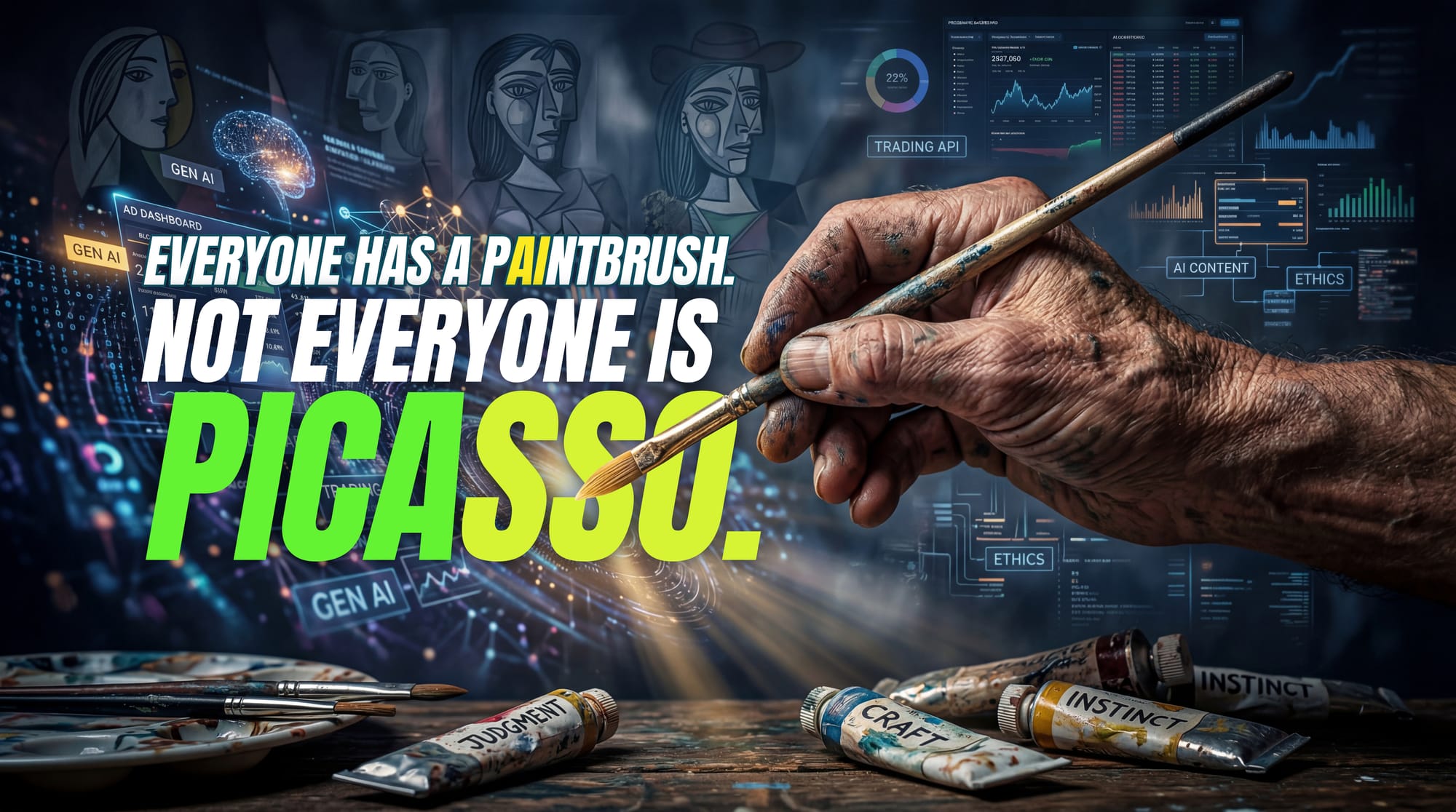
Everyone Has a Paintbrush. Not Everyone Is Picasso.
Sandeep Naug | Head of GTM Strategy, Ads & Content Monetisation | VerSe Innovation
Read
Why AI Gives You the Tools But Not the Judgment to Use Them
Giving everyone a paintbrush does not make everyone Picasso. That is where we are with AI right now. Across media, adtech, and content, the tools are available to almost anyone. The barriers to access have genuinely collapsed.
A publisher in Lagos, a programmatic trader in Jakarta, a content team in Bengaluru: all of them are running on roughly the same AI infrastructure as organizations ten times their size. That is a remarkable thing. It is also, in my experience, where the confusion starts.
Access was never what separated good from great in this industry. What separated them was knowing what to do with it.
AI Moved From Backroom To Boardroom Faster Than Anyone Expected
Three years ago, AI in advertising and media was largely an infrastructure story: smarter bidding algorithms, better fraud detection, faster content tagging. It sat inside the tech stack, mostly invisible to commercial leaders.
That changed. Today, AI touches every layer of how content is made, how consumers are understood, and how inventory is priced and sold. Generative models can produce video and text at a regional scale in dozens of languages. Programmatic platforms have embedded predictive yield layers that can recommend floor prices in real time. AI-driven audience segmentation now runs on first-party signals that were unimaginable in the cookie era.
The shift isn't incremental. In India, publishers who were manually curating regional content a few years ago are now running AI-native studios that produce thousands of pieces daily, each localized for dialect, format, and device. In Southeast Asia, adtech platforms are using AI to match small advertisers with hyper-local inventory that no human sales team could have managed at that scale.
The democratization is real. AI genuinely lowered the barriers to content creation, programmatic access, and audience insight. A mid-sized publisher in Lagos or Manila now has access to tools that would have required a room full of engineers in 2018.
That is the shift. More capability, more broadly distributed, faster than the industry expected.
More Signals. Not Necessarily More Wisdom.
When we started building video content at scale using AI, I assumed the tools would do most of the heavy lifting. Feed in a brief, get a video out. That is not how it works.
To get anything usable, you need to know what a good script looks like before you prompt for one. You need to understand storyboarding well enough to catch when the visual logic breaks. You need to have an instinct for camera movement, voice texture, image composition: not to do those things yourself, but to recognize when the AI has got them wrong. The output is only as good as the craft knowledge you bring to the input. Without that, you get volume. You do not get content.
The same is true in programmatic. AI can optimize a bid, enrich an audience signal, and recommend a floor price in real time. What it cannot do is walk into a room and make a CMO trust that their brand belongs in your inventory. The biggest deals I have worked on did not close because of a dashboard. They closed because of a conversation that happened before the dashboard was ever opened. AI had no role in that room.
AI can harness your talent. It cannot replace it.
This is the gap that does not show up in the case studies. The tools amplify what you already know. If you do not know enough, they amplify the gap instead.
The Practitioners Who Combine Both Will Set The Pace
Knowing the gap exists is not enough. The question is what you do with that knowledge. The practitioners who are pulling ahead are doing three things differently.
Content: From Volume to Value Architecture The next phase of AI in content is not about producing more. It is about producing smarter, with a clearer link between what gets made and what gets monetized. The publishers who will win are those who use AI to understand which formats, which topics, and which audience signals drive real commercial outcomes, and then use human editorial judgment to build content supply around those insights. AI helps you see the pattern. Humans decide what to do with it.
Programmatic: From Automation to Contextual Intelligence The best adtech professionals are starting to think about AI not solely as a bidding tool but as a context-enrichment layer. The question is shifting from 'how do I automate the transaction?' to 'how do I make every impression more defensible to a premium buyer?' AI can enrich inventory signals, map content quality to advertiser outcomes, and identify yield gaps in real time. The human role becomes one of packaging intelligence into commercial narratives that advertisers actually buy. That is a skill, not a feature.
Partnerships: The Relationship Layer Stays Human Across both content and adtech, the commercial partnership layer remains unwaveringly human. The most sophisticated AI systems on the market cannot negotiate a content syndication deal, cannot build the mutual trust that makes a first-party data partnership work, or walk into a room and convince a CFO that their brand deserves to be in a different conversation. These are judgment calls, built on experience and credibility, and they will stay that way for the foreseeable future.
The professional who understands craft will set the price. Everyone else will compete on volume.
The Paintbrush Is Not The Point
Every professional in media, adtech, and digital media now has access to the same palette of AI tools. That access is real, and it matters. But access was never the constraint that separated good from great in this industry.
What separated good from great was knowing what to paint, for whom, and why it mattered. AI does not answer those questions. It just gives you more ways to answer them yourself.
The professionals who treat AI as a productivity amplifier rather than a judgment substitute will produce work that is faster, richer, and more commercially grounded than anything they could have done alone. The ones who treat it as a shortcut will produce a lot of output that lands nowhere.
Shailja Jain | Founder & Artist | Shailja Art Gallery
Read
What I learned about resilience through art
For three months, I sat inside a large, empty, expensive gallery that had nothing in it. We rented the space in October, during the third COVID wave. The idea was simple: start with a solo show in November and see what happened next. But the lockdowns didn’t end as planned. November passed, then December, then January. Each morning, I walked in, turned on the lights, and sat in the quiet, wondering if we had made a mistake.
The truth is, my husband Sudhir and I never planned to open a gallery. I just needed a place to paint. Anyone who’s tried to work creatively at home knows how hard it is with constant interruptions and chores. I wanted a studio with a door I could close. Sudhir listened and said, "You know what, why don't we just make it a gallery?" So we did. And then we sat in it, waiting, wondering.
Before There Was A Gallery
I’ve painted most of my life, though I never went to art school or got a diploma. No one told me I could do this. Wherever Sudhir’s job took us, Bengaluru, Mumbai, Ahmedabad, I kept painting. I taught art classes in every city for kids, women, or anyone interested. At home, we joked that my paintings never piled up because I gave them away to friends moving into new homes. Gathering enough work for a show took patience.
During the COVID period, before we had the gallery, I began teaching online art classes for children from less privileged backgrounds. These kids struggled with textbooks and exams, but they always joined the sessions. They tried new things and got fully involved. For that hour, they disregarded the outside world and just created. At that time, that meant a lot.
The Moment I Understood
When restrictions eased and I held my first show, people came, looked at the art, and shared kind words. Even after years of showing my work in different cities, real reactions from people surprise me. They matter. It felt like passing a test I wasn’t sure I could handle.
But the moment that told me why I'd opened the gallery in the first place came later that year.
A painting I made years ago hung on the wall, a mother holding her newborn wrapped in a towel. I hadn’t planned to paint it. I made it when I was pregnant with my second daughter. My older daughter was four, Sudhir was working long hours, and I was handling everything at home. One afternoon, I picked up my brushes and painted. When I finished, I felt lighter.
Years went by. The painting stayed in the gallery. Then one day, a woman came in, saw it, and bought it for her daughter, who was expecting a baby. It was a way to welcome new life and to say, I understand what you’re about to feel.
A painting made in my own overwhelm, sitting on a wall for years, then moving into another family's story entirely. That is what art does when you let it. It carries something from one person's unspoken feeling into another's, across years and circumstances neither of them could have predicted.
That realization led me to create Sip & Shades, a workshop series for people in the corporate world. I wanted to share this with others, especially those who might not think of themselves as creative but still carry the burden of stress. In a world where pressure has become a persistent part of work and life, I came to see art not just as an expression but as a form of recovery.
I had seen how stress affects people in those workplaces for a long time. It’s not always dramatic burnout, but a steady, constant pressure with no real break. I kept thinking that art could help here.
There is research to support this. A 2016 study byGirija Kaimal and her team at Drexel University found that just 45 minutes of art-making lowered cortisol, the main stress hormone, in 75% of participants, regardless of artistic experience. That mattered to me because it confirmed what I had been seeing firsthand: you do not have to be an artist to benefit from creating.
I found that fascinating and, honestly, a little validating. But I'd also learned from meeting people in corporate settings that the moment you mention painting, they step back. "That's not for me. I'm not creative. I can't draw." So I started being more direct: please come anyway. Just try it once.
Amul was the first company to try it. They opened a hall at their plant and invited employees from different departments. I brought all the supplies: canvases, easels, paints, and aprons. We painted together, step by step, with music, drinks, and snacks.
What struck me, every time, was watching people who came in convinced they couldn't do it, and then, an hour later, standing a little straighter, proud of something they'd made with their own hands. The stress they'd carried had dissolved into the paint.
What A Simple Act Of Making Can Do
A brush and an hour of music seem like a small thing. I know that.
But I opened a gallery during a lockdown and sat in its quiet for three months before anything happened. What I learned during that silence was the same lesson I learned the day I painted a mother and child alone: making something, anything, changes how you feel.
You don’t have to be an artist for this to help. I’ve seen it work for a struggling child, an overwhelmed mother, and a room full of professionals who just needed a moment to catch their breath.
You just need to be willing to begin. In a stressful world, that small act of making can be powerful.
Brett Christoffel | CEO & Founder | All Y'alls Foods
Read
The moment that changed the question
I didn’t gradually change my meat-eating habits. I stopped. Not because of a trend or health goal, but because, in an instant, I realized that all animals, including our pets, are aware and don't want to die. By eating them, I was participating in a system that made someone else do what I could no longer ignore. There wasn’t a transition period. Just a line I couldn’t step back across.
At first, that was personal.
But as my perspective grew, that personal conviction evolved into a larger purpose. Less than a year later, I learned that Texas, where I live, is one of the world's largest beef-producing regions. I remember sitting with that and asking myself a simple question:
Are you going to complain about it, or are you going to do something about it?
That was the moment the problem shifted, from what I consume to what I contribute.
The Gap Between Knowing And Doing
Over the last decade, there has been a clear shift in consumer food-buying behavior, particularly around protein consumption and health.
Globally, more people are questioning accepted assumptions about protein, nutrition, and long-term health outcomes. There is growing awareness that plant protein can meet human needs for amino acids and performance. Medical practitioners are increasingly speaking about the relationship between diet and chronic disease.
There’s also a growing realization that protein alone isn’t the full picture; when it comes from plants, it comes with fiber and phytonutrients, not only isolated protein. And yet, behavior has not fully followed belief.
Most consumers are not actively looking to give something up. They are not searching for restrictions. They are looking for familiarity, satisfaction, and convenience. People are open to change, but only if it doesn’t feel like a loss.
I felt that tension firsthand. Coming from over 45 years on a meat-centric diet, I had real questions, even fear, about whether I would get enough protein, whether I was making a physical mistake. The shift wasn't just external. It was internal. I was asking myself to do something I wasn't sure my body would accept.
For the record: ten years later, without supplementation, my protein levels are perfectly normal. But that fear was real when it mattered. And understanding that fear, from the inside, changed how I reflected on the people I was trying to reach. The question shifted from "How do we educate?" to "How do we design for real-life behavior?"
Where Innovation Still Falls Short
Much of the innovation in alternative protein has missed this. A large portion of the industry assumed that consumers would adopt new products because they are better for them or the planet. In practice, that's not how behavior works.
Taste, texture, familiarity, and identity still drive decisions. Especially in categories deeply embedded in culture, like jerky.
Jerky is not simply a snack. It's tied to routine, memory, and identity. Road trips, time with dad, outdoor culture, and convenience stores carry meaning beyond nutritional value. Most alternatives fail not because they lack nutrition, but because they do not reproduce the experience.
The opportunity isn't just nutritional. It's experiential.
And there's a second gap that shows up at the founder level, one nobody talks about. Conviction can carry you into a problem. It doesn't automatically translate into adoption, and it doesn't protect you from the cost of the years in between.
There were long stretches when I was building, without clear validation. Financial pressure was constant. It created real stress, not just in the business, but at home. There were periods where my focus on building came at the expense of my marriage. I had to learn, the hard way, that conviction doesn't excuse imbalance. That the mission doesn't become an excuse to neglect the person living through it with you. I have since learned how to prioritize my marriage without neglecting my business. That rebalancing was as important as anything I did for the company.
The market wasn't outright rejecting the idea, but it wasn't fully embracing it either. That's a difficult place to operate. Because you're not fighting opposition. You're navigating indifference. And indifference is harder to move.
Designing For Adoption, Not Agreement
What I’ve come to understand is that substantial change in this category won’t come from asking people to change who they are. It will come from giving them a version of what they already want - just better.
Not a different behavior. A smarter one.
Consumers don’t need to stop liking familiar formats like jerky. They need options that deliver the same satisfaction - flavor, texture, and convenience, while improving the nutritional and ingredient profile. That means delivering protein alongside fiber, without cholesterol or saturated animal fat, while still giving people the taste and experience they’re used to.
The future of food industry innovation will depend less on creating new categories and more on improving familiar ones. We’ve already seen this happen with non-dairy milk. People didn’t stop drinking milk; they just found a better version. This is where the opportunity expands.
Because instead of targeting a small, already-converted audience, you’re now speaking to a much larger group: people who are open to improvement but not interested in sacrifice.
I began to see validation in unexpected ways. A vascular surgeon chose to invest in us and became our Medical Director, not because of trends, but because of what he sees every day inside the human body and the long-term impact of diet, especially cholesterol and saturated animal fat.
And in a market where this idea shouldn’t have worked, early signals began to appear, placing in the top ten out of over 800 other brands in a major Texas-based grocery retailer's food competition, eventually earning shelf space in over 100 of their stores. There is no proof that the work is done. But proof that behavior can shift, if you meet people where they are.
What Conviction Is Actually For
The hardest thing about this category is not the opposition. Texas beef country is not subtle about what it thinks of plant protein. But opposition, at least, gives you something to push against. It tells you the idea is alive.
Indifference is different. Indifference means people don't care enough to reject you. They've just moved on to whatever requires less of them. Conviction is what keeps you in the room when that's happening. It doesn't guarantee success. It doesn't remove friction. And it doesn't make the market ready.
What it does is anchor you when none of those things are present. There were moments where improvement was minimal, pressure was high, and outcomes were uncertain. But conviction, when it's grounded in something real, doesn't need external validation to continue. It just needs to be carried out long enough to find agreement with the market.
Conviction doesn't ask for permission. It asks whether you're willing to see it through. Conviction is where this starts, but it’s not where it ends.
How overlooked markets, funding blind spots, and embedded bias are defining the next frontier of health innovation
Imagine receiving approval in 2017 for a patent on something as simple as a sponge or a pen, an everyday object whose basic function seems obvious. Yet this is essentially what happened when my patent for a new type of hygiene device for women was approved. The experience revealed something that every operator in health innovation eventually confronts: the most significant market gaps are often the ones that have been hiding in plain sight. For those of us building in women's health, this is not an abstract observation. It is the daily operating reality.
Today, we may finally be reaching a turning point, but it will require founders, investors, and operators to make decisions different from those they have made in the past.
I was born 55 years ago into a society where my father, the man, was the breadwinner, while my mother, the woman, worked part-time and managed all the housework. From the very first moment I entered this world, I was exposed to patterns of gender inequality that became subconsciously ingrained. It was always clear to me that I was not expected to perform or achieve the same accomplishments as my older brother. I grew up like many of my peers, sharing similar patterns of thought and expectations.
As an Israeli, I knew that when I grew up, I would serve in the army, but meaningful roles, pilot, fighter, would be closed to me because of my gender. I also knew I would retire earlier than men. The childhood stories of Snow White and Cinderella created in my mind the dream that one day a perfect, strong prince would take care of the family and me, and we would build together. That has since changed; women in Israel can now serve in almost all roles, but the mental frameworks those expectations created take far longer to rewrite.
It took me many years to recognise some of my own blind spots regarding gender inequality and to gradually remove them one by one. These were things I had taken for granted without realising they did not have to be this way. One such moment occurred when a company calledEgal introduced a new toilet-paper-style sanitary pad that solved a long and painful problem shared by menstruators around the world. A relatively simple technological solution, yet it had not existed before. This is a strong example of how gender-focused technology can close gaps that arise directly from anatomical differences, gaps that went unaddressed not because the solution was technically complex, but because the people controlling research priorities and funding did not experience the problem themselves.
As a woman entrepreneur working in women's health for over 20 years, I have experienced firsthand many of the structural blind spots surrounding gender gaps - in funding, in research, in market assumptions. These gaps were partly created by anatomical differences between the sexes, which means health innovation sits at the doorway of closing them. The opportunity is significant. So is the friction.
The Funding Gap Is Not Only A Man's Problem
Women often believe that these gaps exist only in men's thinking. In my experience, that is not the case. One of the main factors still holding back women's health innovation is the blind spots in women's own decision-making - our internalised biases about risk, return, and what constitutes a serious investment opportunity.
It is no secret that women invest significantly less than men, and when they do, they tend toward more conservative risk profiles. When we examine how the wealthiest women in the world deploy their resources, we often see a preference for philanthropic causes over early-stage innovation. Many of the funds created specifically to support women, including those offered by organisations such as Pivotal, founded by Melinda Gates, are structured for non-profits and are not accessible to commercial ventures like mine.
This matters because risk capital is what turns early-stage health innovation into workable products. Women's health companies cannot expect male investors to deeply understand problems they do not personally experience; it is only natural that people hesitate to fund problems they do not fully grasp. But significant change will only come when women investors and operators recognise and actively override these blind spots. The frustration is legitimate. The solution requires action, not just acknowledgment.
The Systemic Risk Hiding In The Data
Beyond funding, a more systemic risk is emerging that operators cannot afford to ignore. Our mental frameworks are usually shaped in ways that lead women to perceive themselves as less capable and to expect less of their own potential. Artificial intelligence, which is increasingly influential in decision-making across industries, has been shown to contain inherent gender biases. The reason is clear: large language models are trained with vast collections of published text, much of which reflects centuries of gender inequality. As a result, instead of helping to eliminate existing gaps, these systems risk preserving them within our collective digital infrastructure.
This is not a philosophical concern. It is an operational one. AI is now embedded in hiring decisions, medical diagnostics, research prioritisation, and investment screening. If these systems carry embedded gender biases, they will not simply reflect the inequalities society is trying to overcome; they will accelerate them at scale.
A Better World For Everyone
More than forty years ago, humanity walked on the Moon through bold technological innovation. Yet here on Earth, medicine still struggles to properly address conditions such as endometriosis, menopause, fibromyalgia, and many other health challenges influencing millions of women globally. These are not niche concerns. They represent some of the largest addressable gaps within modern healthcare, and some of the most significant commercial opportunities for founders and investors willing to look.
The solutions exist, or can be created. Gender-focused technologies and research have the potential to dramatically improve women's health and close longstanding gaps.
But the market will not self-correct. It requires operators- founders, investors, researchers, and executives, to make deliberate choices about where they direct capital, talent, and attention.
Those who build here first will not only advance women's health. They will have shaped one of the most consequential and underserved markets of the next decade.
Universities Are Facing the Question Your Business Is Dodging
Somayeh Aghnia | Co-Founder | London School of Innovation
Read
Three horizons. Most organisations only manage one.
When you ask your leadership team what return they expect from AI adoption, you are likely to get one of two answers: either a confident efficiency number (hours saved, costs reduced, throughput increased) or an uncomfortable silence dressed up as "It's difficult to calculate, so we are still exploring it."
Calculating the real ROI of AI adoption, not simply as a new disruptive technology but as a new value-creation paradigm, requires your leadership team to hold three very different definitions of success simultaneously:
What efficiency can we capture now?
What value can we create for our stakeholders in the medium term?
And the one that most teams quietly avoid: why does our organisation exist in a world where AI will be doing more of what we used to do?
No sector is being forced to answer all three of those questions more publicly than universities. That is why they are worth paying attention to, not as a model to copy, but as an early warning system for what is coming.
The Three Horizons Of AI Adoption ROI
Most AI adoption ROI conversations are built around the horizon one: efficiency and productivity. That is where the business case is easiest to make, the wins are fastest to show, and the board is easiest to satisfy. Efficiency gains are real, they matter, but they are not a strategy for business success.
Look at universities right now. They are under serious pressure as margins are shrinking, costs keep rising, and public funding is under greater scrutiny. AI adoption is legitimately the way to help them manage that pressure by automating administrative workflows, streamlining student services, and trimming operational overhead: measurable, defensible, necessary.
This is where most businesses would focus, but universities are largely focused on horizon two, and I explain why below. They are trying to save their existing business model: How do you assess students when AI can write the essay? What is the value of a lecture when the content is freely available and infinitely personalisable? What does research mean when AI can synthesise literature, generate hypotheses, and accelerate analysis? These are not future concerns. They are live operational problems sitting on the medium-term horizon.
And the reason universities are prioritising horizon two over horizon one goes back to their historical strength and largely unchallenged position. Universities didn't have to be efficient; most are not private institutions under pressure to turn a profit, so they haven't had to build muscle for productivity gains. The medium-term question of how they maintain stakeholder trust among students, employers, governments, and academics takes priority. They need to ensure assessments work, lectures remain valuable, and research is still seen as a distinctly human endeavour.
Most businesses can extract enough value from horizon-one efficiency gains for now without confronting horizon two.
And then, underneath both horizons, is the long-term question universities can no longer defer- horizon three: why should someone go to university at all? When the future is genuinely unclear, and AI will transform most of the careers graduates are preparing for, the notion that "university exists to prepare you for your future" becomes heavily contested. No amount of short-term efficiency or revised assessment models can resolve this.
Read that third horizon question through a business lens:
In a world heavily augmented by AI, why should someone use my organisation and what it offers, at all?
McKinsey's State of AI 2025 found that while 88% of organisations now use AI in at least one business function, only 6% qualify as genuine high performers generating meaningful bottom-line impact. That is not a deployment problem. It is a definition problem. Organisations are measuring AI ROI against the horizon they were already managing, and calling that the whole picture.
Universities expose this gap most visibly. An institution that successfully redesigns its assessment models while students are questioning the value of tuition is not winning. It is losing more slowly. If the long-term purpose question is never answered, the efficiency gains are just buying time.
Businesses face exactly the same dynamic, just with different labels on the horizon.
Horizon one: where can AI reduce cost and accelerate output? Horizon two: how do we redesign our value proposition when AI is changing what customers actually require from us? Horizon three: what is this organisation for in a world where AI is doing more of what we built it to do?
Three horizons. Three different definitions of success. All live at the same time.
The organisations that are dodging the third question are just deferring the hardest part of the calculation.
We built our institution as AI-native from inception, using AI as a lens for curriculum and assessment (horizon two) and for operational optimisation (horizon one). And our daily conversation is not about tools or efficiency. It is about why we should exist at all, and what future of the university we are trying to create. That question puts enormous pressure on every choice we make. We are learning to move on ground that is not stable, and never will be. It is the most uncomfortable position I have occupied as a leader.
AI Adoption Roi Requires Leadership Teams That Can Hold All Three Horizons At Once
The practical implication is uncomfortable but clear: measuring AI adoption ROI properly means your leadership team must work across all three horizons simultaneously, not sequentially.
That means: Horizon one: capturing short-term efficiency wins while actively asking which of those efficiencies are building toward something, and which are simply buying time.
Horizon two: addressing the medium-term disruption to your value proposition before it becomes a crisis, rethinking what you deliver to customers, employees, and partners in a world where AI is changing what they are willing to pay for.
Horizon three: naming the long-term purpose question out loud, even when the answer is not yet clear, because the cost of not asking it is higher than the discomfort of sitting with uncertainty.
Watch university leadership teams right now. See who is holding space for all three horizons simultaneously: cutting costs today, redesigning teaching and assessment for the medium term, and genuinely interrogating what a university is for when the world their graduates are entering is being remade by AI.
Universities cannot continue doing what they do today. That is now a given. The ones that survive and matter will be the ones that figure out what they are for in the world that is actually arriving.
The same is true for your organisation.
The question is not whether AI delivers ROI. It does. The question is whether you are measuring the right return, across all three horizons, before it is too late.
The data is smarter than ever. The decisions are harder than ever. And somewhere between instinct and algorithm, football (soccer) is trying to figure out who still gets to call the shot.
If you've spent any time in professional sport over the last 2-3 years, you've felt it.
Who gets to decide?
Is it the head coach with twenty years of pattern recognition embedded in his or her nervous system? Or the analyst running predictive models trained on tens of thousands of match events? Or the board demanding measurable return on investment? Or the algorithm that identifies relationships no human eye could possibly detect?
The fans know it too. They yell about VAR. They don't like plenty about the modern game. But most of them also quietly admit, parts of it have gotten way better.
The Tools Arrived Before The Trust Did
As AI systems become embedded across global football operations, from recruitment to load management to fan engagement, organizations are not simply adopting new tools. They are renegotiating trust. And that negotiation is uncomfortable.
For decades, football decisions were made under constraint. Performance data had been fragmented. International communication and collaboration were slow. It still is in some ways. Intuition was a differentiator.
Today, those constraints have largely collapsed. Clubs at nearly every tier now have access to event data across leagues, computer vision tracking, predictive injury modeling, contract valuation simulations, and automated opponent analysis. What was once available only to elite federations is gradually accessible to mid-tier clubs and emerging markets.
This shift is global, and the promise of this evolution is simple and compelling: more data should imply fewer mistakes. As of 2025,three out of four professional sports teams globally rely on real-time AI-driven analytics for performance and strategy, and football leads all team sports in adoption rate.
The Human System Hasn't Caught Up
However, beneath that promise exists a deeper tension. We have optimized our ability to generate insight far faster than we have evolved our capacity to absorb it and possibly come to terms with its capabilities. The division between human expertise and machine capability is not purely technical. It is psychological, organizational, and cultural.
Artificial intelligence excels at recognizing patterns amid broad datasets. It can detect performance decline, predict fatigue risk, and flag underappreciated players in secondary leagues. Premier League clubs using AI-powered workload monitoring have reportedinjury rate reductions of over 20%. Yet football is not only a data problem. It is a meaning problem. A model may identify declining sprint metrics. A coach may see a player dealing with personal stress, adjusting to a new country, or responding to locker room dynamics.
AI recognizes correlation. Humans interpret context.
Once algorithms begin influencing playing time, contract renewals, and youth selection, the concern is not always that the numbers are wrong. The concern is that nuance disappears. And nuance is where the identity lives.
There is also the matter of accountability. In traditional football hierarchies, responsibility is clear. The sporting director signs the transfer. The coach selects the lineup. The board approves the budget. When decisions become described as AI-informed, ownership may blur. If a model strongly recommends a player acquisition and it fails, who is accountable?
Executives quietly wrestle with a difficult question. Are we augmenting human decision-making, or are we insulating ourselves behind algorithms?
Football makes this conversation more complicated because it operates within an emotional economy. This is not manufacturing or logistics. It is tribal, cultural, and often irrational. Supporters do not chant for data models. They chant for heroes. They attach meaning to narrative, sacrifice, and identity.
As AI systems begin shaping recruitment pipelines and tactical frameworks, some stakeholders fear sterilization. They worry about artistry being reduced to optimization. There is unease that algorithmic convergence could standardize playing styles across leagues and continents, subtly narrowing the diversity that gives football its richness.
At the human level, adoption anxiety is real. For analysts, scouts, and coaches, AI can feel existential. If systems can automatically generate scouting reports, simulate match outcomes, forecast fatigue, and suggest tactical tweaks, where does that leave decades of experiential mastery?
The anxiety is rarely stated openly. But it surfaces as resistance, as hindered implementation, as quiet skepticism during executive meetings.
Historically, technology replaced repetitive labor. Artificial intelligence increasingly encroaches on cognitive territory. That feels different because it questions identity rather than the task.
From a purely operational perspective, resisting AI makes little strategic sense. Competitive landscapes are tightening. Player markets are globalizing. Financial scrutiny is increasing. Ignoring intelligent systems is not a sustainable path.
Yet adoption still feels threatening, and that's the crazy part. It shouldn’t. Who wants to spend days on end labelling images and people when they could be outside training and learning in the real world? Part of that fear stems from identity disruption. Many leaders in sport built their careers on intuition refined over decades. When an algorithm disagrees with a veteran scout, it does not simply challenge a conclusion. It challenges authority, experience, and, very likely, self-worth.
Another part originates from cultural lag. Technology adoption cycles move in quarters. Cultural adaptation unfolds over the years. Boards push for innovation to sustain competitiveness. Coaching staff require psychological safety to experiment. Youth academies rely on trust built over generations. When AI integration outpaces organizational readiness, friction is inevitable.
There is also the issue of opacity. When a neural network flags a prospect as high-potential but cannot explain its reasoning in language accessible to decision-makers, skepticism from the people it influences is entirely rational. Transparency is not a luxury in football ecosystems. It is essential, and without it, adoption can feel like surrender, so resistance becomes the rational default.
Coexistence Is The Competitive Advantage
Looking forward, the future of AI in football will not be determined solely by model accuracy. It will be formed by how organizations design coexistence between machine precision and human decision-making. It is still a beautiful game with AI.
The most durable structures will be human-in-the-loop systems in which algorithms surface insights, although decisions remain explicitly owned by people. Rather than automation replacing authority, augmentation will define the next era. Clear decision rights will matter as much as predictive power.
Explainability will likely become a competitive advantage. Systems that translate model outputs into interpretable reasoning will earn trust faster across locker rooms and boardrooms alike. Ethical governance will also shift from an afterthought to a strategic differentiator. Questions about biometric tracking, youth data collection, bias mitigation, and data ownership will not go away. Organizations that address them proactively will build stronger ecosystems. They will.
Above all, it is worth remembering that football remains a human theater. AI may optimize variables, forecast probabilities, and compress analysis time. It cannot replicate collective belief, resilience under pressure, or the chemistry that turns individuals into a team.
We are not witnessing the elimination of human judgment in football. We are witnessing its current confrontation.
Dr. Sanjeev Dixit | Founder & Chief Culture Officer | Rudra Plan C People Advisory & Upskillsmes.com
Read
The aspirational talent imperative for CXOs
If you and I were sitting across a table discussing growth strategy, you might say: "We need more innovation. More agility. More people who think differently.” And then, in the very next hiring meeting, someone asks: "Do they fit our culture?” That one question often carries more weight than the strategy deck. It quietly decides whether you’ll build for the future, or preserve the past.
Shift: From Stability To Volatility
Across markets, from India’s digital acceleration to Brazil’s industrial reinvention and Europe’s energy transition, the competitive environment is no longer linear. Technology cycles are shrinking. Customer expectations are rising. Business models are evolving in real time.
Consider what has happened in the last decade alone. Traditional retail has been disrupted by digital-native platforms. Automotive companies are becoming software companies. Manufacturing firms are investing more in analytics and automation than in infrastructure expansion.
In those environments, yesterday’s expertise quickly becomes tomorrow’s limitation. Yet our hiring practices often remain rooted in an earlier era, one where predictability mattered more than adaptability.
For decades, “culture fit” felt safe. It minimized friction and fostered cohesion. But in times of uncertainty, cohesion without challenge breeds complacency.
Research supports this. Studies from leading business schools show that cognitively diverse teams solve complex problems faster and generate more creative solutions than homogeneous groups. McKinsey’s global research on diversity has repeatedly demonstrated that companies in the top quartile for diversity outperform peers in profitability. Boston Consulting Group has found that organizations with diverse leadership teams generate significantly higher revenue from innovation.
The shift is: we are no longer competing on efficiency alone. We are competing on adaptability. Adaptability does not come from sameness.
Gap: Where Talent Strategy Falls Short
When leaders say “culture fit,” what we often mean is someone we are comfortable with, someone who thinks like us and won’t disrupt the rhythm. It sounds practical. It appears intuitive. It is truly human. But it creates three invisible risks.
First, innovation erosion. Homogeneous teams converge quickly. Consensus feels like progress. But consensus built on shared assumptions rarely produces breakthrough thinking. The 2008 financial crisis exposed how groupthink within highly educated, like-minded leadership teams contributed to systemic blind spots.
Second, talent drain. High-potential individuals who think differently often disengage within environments that subtly reward conformity. Great Place to Work data shows that employees who feel excluded or unheard are significantly more likely to leave within 2 years. Attrition at senior and mid-management levels becomes a silent tax on growth.
Third, strategic blind spots. Rapidly changing industries require multiple cognitive lenses. Kodak’s inability to adapt quickly, despite inventing digital photography, is a classic example of organizational inertia reinforced by internal consensus.
Technology can scale processes. Only diverse thinking can scale intelligence. That is the gap.
Next: From Culture Fit To Culture Add
The alternative is what I call the Aspirational Talent Imperative: hiring not for who we are, but for who we must become. Instead of asking, “Does this person fit our culture?” ask, “What does this person bring that we are currently missing?”
That question reshapes the conversation.
Hire for aspirational alignment. Evaluate candidates against your future ambition, not your historical comfort zone. If your strategy calls for digital transformation, global expansion, or customer-focused innovation, your hiring must reflect that aspiration. When one global manufacturing company shifted from hiring primarily mechanical engineers to including data scientists and behavioral economists in leadership roles, productivity improved, not because existing employees were incapable, but because new thinking reframed old processes.
Engineer constructive friction. This is not chaos, it is a structured challenge. High-performing boards and executive teams often assign rotating devil’s advocates to stress-test strategic decisions. Documenting minority opinions before final approval prevents premature convergence.
Measure cultural evolution. Most organizations measure alignment. Few measure evolution. Ask whether new ideas come from diverse sources, whether assumptions are regularly challenged, and whether leaders are comfortable being questioned. Organizations that embed dissent as a discipline, rather than suppress it, build resilience. During the pandemic, companies that encouraged cross-functional debate pivoted faster than those waiting for centralized consensus.
Here are two "culture value add" moments from my own leadership journey.
In my previous stint as CHRO of a large manufacturing organisation: a promotion that upgraded the conventional operating system. In one succession discussion, the safe choice was a high-performing insider, strong execution, widely liked, and fully aligned with how things had always been done. We instead promoted a leader based on potential, assessed through a scientifically designed and deployed Growth Centre, which offered a different lens: data-led problem-solving, tougher shop-floor discipline, and the nerve to question long-held assumptions about manning and accountability. The first month felt uncomfortable, more debate, more pushback. By the next quarter, reviews had turned evidence-based, improvement ideas started coming up from the shop floor, and decision speed picked up as problem framing sharpened. That promotion didn't just fill a role; it lifted capability.
A similar story in an Indian-origin Personal Care and Healthcare organisation: a hire that raised learning velocity.For a business-critical role, "industry fit" and "style fit" were tempting shortcuts. We chose a leader who brought fresh consumer insight, a different way of thinking, and the confidence to disagree respectfully in senior forums. The impact wasn't one dramatic initiative. It was a steady stream of better questions: which customer segments were we under-serving, which channels were being under-used, and which assumptions had gone unchallenged for too long. The team's learning velocity went up, and better decisions followed.
Both instances share the same pattern: short-term discomfort, long-term advantage. In my work with organisations across sectors, I've observed that most businesses operate in one of four modes. Plan A is pure execution, strategy-driven, action-oriented, and focused on delivering what's already been decided. Plan B is defensive, risk-averse, built around protecting existing positions rather than building new ones. Most organisations spend their entire lifecycle cycling between these two, mistaking activity for progress.
What genuinely transforms organisations is the shift to Plan C, Culture-led Business Transformation, where leadership deliberately builds the conditions for different thinking, diverse challenges, and sustained reinvention. When Plan C takes root, it naturally gives rise to Plan D, a Disruption-oriented Thinking Culture, where questioning assumptions isn't a threat to stability but the very engine of it.
The two promotions described above weren't lucky outcomes. They were the result of leaders willing to move past the comfort of Plans A and B and build something harder and more durable. That's the real distinction between a business manager and an authentic leader.
The Leadership Courage Factor
This approach requires significant personal and professional courage and not tentative managerial conditioning. It’s easier to hire people who mirror us than people who stretch us. But markets reward evolution, not nostalgia.
In your next hiring discussion, try this experiment. Instead of debating fit, ask: “If this person rebuilt our culture tomorrow, would we be stronger for the future?” If the answer is yes, you’ve found aspirational talent. The future belongs to organizations brave enough to choose evolution over comfort.
Never Miss a Story
Subscribe to our newsletter to get the latest updates directly to your inbox.