How a lifetime of compensating for what I could not hear became the blueprint for spatial intelligence
For most of my life, I thought constantly scanning my surroundings was simply something I had to do. I've been hard of hearing since childhood. I received my first hearing aids when I was four years old, and over time I learned to pay attention differently. I watched faces. I noticed movement. I checked what was happening to my left and to my right. In unfamiliar places, I became even more alert. I learned to piece together information I couldn't always hear. Eventually, it became automatic. Walk into a room. Scan it. Notice who's moving. Watch people's expressions. Look for anything that might indicate something happened that I didn't hear about.
I became very good at compensating. But being good at compensating does not mean the compensation is effortless. There is a psychological strain that comes with constantly wondering, Did something happen behind me? Did someone call my name? Was that important? Am I missing something? Do I need to react?
For years, I thought that was simply part of my life. I did not realize that so many other people were doing similar work every day, adapting to spaces and situations that were not built with them in mind. Then I began asking a different question: Why should that responsibility fall on us? That question changed the way I saw everything.
From Adapting Myself to Questioning the Design
Somar360 didn't begin because I sat down and searched for a startup idea. It began when I stopped seeing my experience as something I simply had to work around and started seeing it as a design problem. If you've ever watched a user struggle with a product and thought "they'll figure it out," you've seen the same instinct from the other side of the table.
My path into technology began behind the wheel of a semi-truck. I was a Class A CDL driver while studying computer science and AI, and I kept thinking about how technology could better reflect the way people actually live and work. I did not start out knowing how to build a hardware company, lead an engineering team, or create an AI platform. What I did know was the problem I wanted to solve. From there, I learned what I needed to bring that idea to life.
I talked with engineers, advisors, researchers, accessibility experts, and the people we hoped would use what we were creating. I learned that product and technical decisions are closely connected, that turning an idea into something real takes many small choices, and that it is easy to lose focus without clear priorities.
Much of that early work happened from the passenger seat of my husband’s semi-truck. There was no polished founder story or moment when I suddenly felt ready. I just kept going, learning as I went.
Leadership Started Before I Felt Ready
One of the biggest lessons this journey has taught me is that leadership is not the same as knowing everything. For a long time, I think many of us have imagined leaders as people who walk into a room already certain of themselves, already experienced and already equipped with every answer. That has not been my experience.
Leadership, for me, has meant being able to say, “I don’t know yet, but I’ll find out.” It has meant inviting people with more experience to challenge my assumptions and help me see what I might be missing.
It has meant making decisions before I had all the answers, changing course when I learned something new, and taking responsibility for how things turned out. Above all, it has meant not doubting my place simply because my path has looked different from other people’s.
I didn't grow up imagining that I would become the founder and CEO of a technology company. But I've learned that you don't have to wait until you feel like the person capable of doing something before you begin. Sometimes you begin first. Then you become that person through work. I'm still becoming her.
More Alerts Are Not the Same as More Awareness
Technology can notice more than ever before. AI can recognize patterns. Wearables can communicate through touch, sound, and visuals. Devices can interpret parts of the physical environment in ways that were much harder only a few years ago. But I keep returning to the same problem. We have become very good at generating alerts. We are not always as good at deciding which alerts matter.
A phone buzzes. A watch vibrates. A screen flashes. But you are still left figuring out what actually happened. Where did it happen? Does it matter? Should you do something? If you have ever stared at a dashboard packed with numbers and no clear priorities, you know the feeling. Or dealt with alerts that all demand your attention at once. Or use a smart assistant that throws every detail at you but does not help you choose what is truly important. The technology notices more, but people are still stuck sorting through the noise.
That's the gap I want to explore with Somar360. The goal is to make important information about the environment easier to understand. My experience is only one experience. I'd never claim the way I move through the world represents every Deaf or hard-of-hearing person. But living this taught me something no market report could: when people become extremely good at adapting to a problem, the rest of the world can stop noticing it.
Building Before the Answers Are Perfect
Somar360 is still a pre-prototype. More than 100 people have joined our early beta waitlist before there is a functional product to test. That means a great deal to me, but I do not call it product validation. There is not a product to validate yet. To me, it is a signal that I may not be the only person asking these questions. Real validation will come when people can use what we build and tell us what works, what does not, and what we misunderstood.
That distinction matters to me because leadership means being honest about where you are. You can be ambitious about the future without acting as if you have already figured everything out.
Spatial Intelligence for People
We're starting with Deaf and hard-of-hearing users because that's where my own experience gives me a real place to begin. But this need goes far beyond one community.
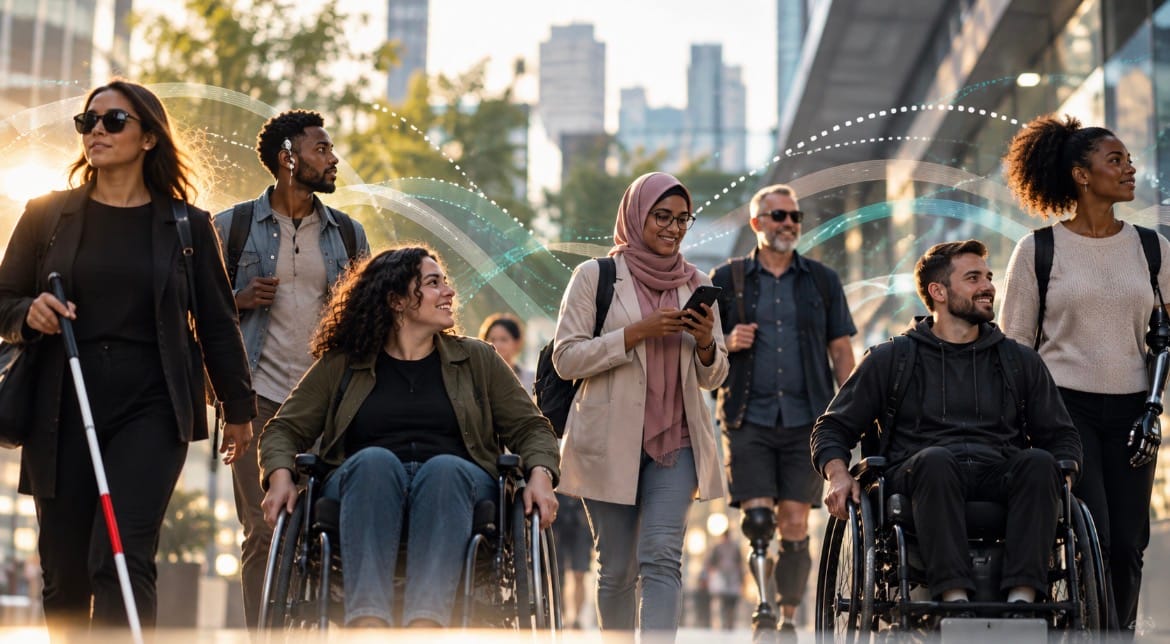
Someone wearing headphones, working near loud machinery, getting older, traveling somewhere unfamiliar, or responding to an emergency may all miss important cues around them for different reasons. The situations are different, but the need is the same: understanding what is happening nearby and what needs their attention right now.
That is why the larger vision for Somar360 is Spatial Intelligence for Humans. We are starting with a focused first product because Gen 1 does not need to prove every future possibility. It needs to prove the core experience. Over time, I believe spatial intelligence can extend across different devices, environments, and human needs. That is what I mean when I say: Born from lived experience. Built for everyone.
What I Know Now
For most of my life, I adapted, scanned, watched, and compensated. Building Somar360 began when I stopped assuming that was simply the way things had to be. Your starting point does not have to look like anyone else's. You do not have to know everything before you begin. You do have to be willing to learn, to get things wrong and to keep going.
I know this problem is real because I have experienced it myself. Over time, a question rooted in my own life grew into something bigger: What if technology could help more people make better sense of the world around them?
That's the future I want to help build. We're still at the beginning, and there's a lot more work ahead.