
After 35 years in disability inclusion, I believe AI offers us an extraordinary opportunity to rethink exclusion. But technology cannot change systems we are unwilling to question.
When I was in high school, I noticed something that bothered me. There were plenty of clubs and activities, but some of my friends, including friends with disabilities, weren’t being included.
So my brother, his best friend, and I started our own club.
We welcomed the artists, the creative thinkers, the students who saw the world differently, and people who hadn’t found a place in the other groups. What started as a small idea became one of the most popular clubs in the school.
That experience taught me something I’ve carried throughout my life. When we stop deciding who belongs and start creating opportunities for everyone to participate, extraordinary things can happen.
Now, after 35 years working in accessibility and disability inclusion, I find myself asking a much bigger version of that same question.
Why have we accepted so much exclusion in a world that has always been filled with human diversity?
Think about the systems we have created. Schools that cannot accommodate children with disabilities. Transportation that people cannot use. Housing that is inaccessible. Employment systems that routinely overlook talented people because their minds or bodies work differently.
Disability is part of being human. Some of us are born with disabilities. Others acquire them through illness, injury, or aging. Many of us experience disability within our families. Yet we continue designing society as though disability is an exception rather than an ordinary part of the human experience.
And now artificial intelligence is challenging what we once believed was possible.
The Shift: AI Is Expanding What Is Possible
I am genuinely excited about the potential of AI. Not because I believe technology will solve every problem. It won’t. But because AI gives us opportunities to remove barriers, connect people, share knowledge, and rethink how our systems work.
Imagine a child with complex communication needs having more ways to express their ideas. Imagine people accessing information in their own languages, regardless of where they live. Imagine a small disability-led organization in Africa, Asia, or Latin America being able to participate more effectively in global conversations without needing the resources of a large international institution.
These possibilities matter.
As someone who is neurodivergent, I also know personally that there is no single correct way to think, learn, communicate, or contribute. Technology should adapt to human diversity, rather than forcing human beings to adapt to systems designed around narrow assumptions.
Through Billion Strong, we have built relationships with disability leaders and advocates across a network engaged in 142 countries. The diversity of perspectives is extraordinary. But so are the differences in resources, infrastructure, access to technology, and opportunities to influence decisions.
AI can help organizations like ours connect, communicate, research, and work across borders in ways that once required much larger teams and budgets. That is an important shift. It creates opportunities for organizations and communities that have historically been excluded from global decision-making.
But opportunity is not the same thing as inclusion.
A technology is not truly inclusive if people cannot afford it, access the internet, understand its language, or influence how it is developed.
And we must recognize the real concerns surrounding AI, including bias, privacy, misinformation, employment disruption, and environmental costs. These concerns deserve serious attention. But I do not believe fear should prevent us from exploring technologies that could significantly improve people’s lives.
The question is not simply what AI can do.
The question is who gets to shape what AI does, who benefits, and who is left behind.
The Gap: We Cannot Keep Demanding Inclusion Without Examining Ourselves
This is where the conversation becomes uncomfortable.
For decades, the disability community has challenged governments, employers, technology companies, and other institutions to become more accessible and inclusive.
We have been right to do so.
But I believe we also need to ask difficult questions about our own organizations and networks. Are we practicing the inclusion we demand from everyone else?
Are persons with intellectual disabilities genuinely influencing decisions? Are Deaf people included in global conversations with the communication access they need? Are people with complex support needs welcomed into leadership and participation? Are grassroots advocates in low-resource communities helping shape priorities, or are they simply invited to support decisions others have already made?
Who controls the funding? Who sets the agenda? Who gets invited into the room? And who is still missing?
I see disability organizations sharing beautiful AI-generated graphics without alternative text. I see conferences about inclusion that fail to make participation accessible to all disability communities. I see passionate advocates discussing representation, even as the same voices continue to dominate international conversations.
I don’t raise these questions to criticize people who have spent their lives fighting for disability rights. I am part of this movement, and I believe deeply in it. I raise them because I believe we can do better.
That belief led us to create Disability Mirror™, an evidence-based reflection initiative that invites the disability ecosystem to look inward.
In its first year, Disability Mirror examines 50 influential organizations, including Billion Strong itself, across seven domains covering governance, funding transparency, participation, accessibility, safeguarding, learning, and emerging technology accountability.
It is not a ranking, certification, or competition. We are not giving organizations grades. We are creating a clearer picture of where we are today, what we can learn from one another, and where we need to improve.
Because if we want a more inclusive world, we must be willing to examine the systems and organizations we have built ourselves.
That includes my own. And it includes how our community approaches AI.
Technology can amplify existing power structures just as easily as it can challenge them. If we develop AI around the perspectives of those who already have resources, access, and influence, we risk reproducing the very exclusions we claim to oppose.
We cannot build a more inclusive future by simply making today’s unequal systems faster and more efficient.
The Next Step: Move From Participation to Shared Power
For business leaders, policymakers, technology developers, and disability organizations, I believe the next step requires more than another commitment to inclusion.
It requires changing how decisions are made.
First, persons with disabilities must help shape technology and policy from the beginning, rather than simply being invited to provide feedback after important decisions have already been made. Their expertise should be valued, compensated, and reflected in governance and funding decisions.
Second, we need to stop treating accessibility as an additional feature or expense. It should be part of how we design products, services, workplaces, education, and communities from the start.
And third, we must create opportunities for communities to identify their own priorities rather than assuming that the most visible or best-funded organizations speak for everyone.
This is especially important globally.
The priorities of a disability advocate in rural Kenya may differ markedly from those of a professional working in London or New York. Access to transportation, education, communication, assistive technology, or basic infrastructure may be far more urgent than the innovations dominating technology conferences.
We must listen before assuming we understand what people need.
That is why convening people matters so much to me. Through Billion Strong, we want disability communities around the world to have greater opportunities to connect, share knowledge, identify common challenges, and influence the decisions shaping their lives.
AI can help us support that work at a scale we could barely imagine a few years ago. But technology cannot decide that every human being deserves a place in society. That decision belongs to us.
The Future We Choose
I have spent much of my life advocating for people who have been overlooked, underestimated, or excluded. And after 35 years, I am still hopeful.
I am hopeful because I see more people questioning the systems we have inherited. I see disability leaders demanding greater accountability, and I see emerging technologies creating possibilities that were once unimaginable.
But hope without action changes very little.
We have talked about inclusion for decades. We have written policies, created programs, held conferences, and celebrated progress.
And yet billions of people still face barriers to full participation in society.
Now we have new tools, including AI, that could help us accelerate meaningful change.
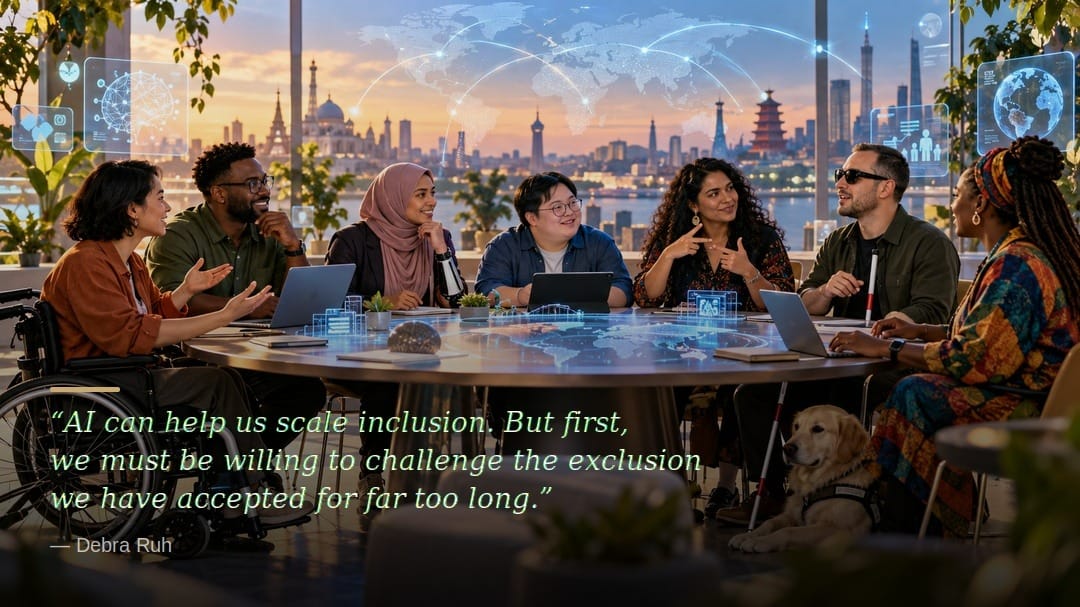
AI can help us scale inclusion. But first, we must be willing to challenge the exclusion we have accepted for far too long.
I don’t want a future where technology becomes more sophisticated while humanity continues leaving people behind.
I want us to build a world where human diversity is expected, where people have genuine opportunities to contribute, and where everyone has a voice in shaping our shared future.
We have an extraordinary opportunity in front of us.
The question is whether we will have the courage to use it differently.