

What the Gita teaches us about why independent thought gets relabelled in the workplace
Somewhere between the boardroom and the shop floor, a strange transformation takes place. An employee who once asked sharp questions, pushed back gently but firmly on a flawed strategy, and offered feedback anchored in genuine observation, is quietly recast. No longer "engaged." No longer a "team player." Instead: resistant to change. Difficult. Not aligned.
If you have ever watched someone get quietly relabelled after saying something true, you know exactly how this works.
I have spent two decades building sales and distribution strategy across India's most demanding markets. I have watched this transformation happen to colleagues, to teams I led, and, more than once, to myself. Understanding why it happens requires looking somewhere most corporate playbooks never look: the Bhagavad Gita.
A Retail Expansion, and a Partner Called B
A few years ago at Apple, we were working on a retail expansion plan. Leadership had opened the floor for a genuine strategy discussion: which partner to go with, and how explicitly positioned as work in progress. At the planning meeting, I presented my data-backed view on why Partner A made more sense than Partner B: market fit, execution capability, and long-term scalability.
Leadership eventually chose Partner B. That wasn’t the problem; leaders can see things a regional view may miss. What struck me was that my open support for Partner A, the kind of discussion leadership had asked for, began to be seen as resistance after the decision.
But that was never my intent. Once a call is made, my instinct has always been to get genuinely convinced of why it makes sensenot to perform an agreement, but to actually understand it so I could carry that conviction to my team, the people who would execute on the ground. A leader who doesn't believe in a decision cannot communicate it credibly downstream. Seeking that conviction was the job. To someone watching only the optics, it looked like I hadn't let go.
The Moment the Shift Happens
Independent thinking doesn’t usually look like rebellion. It often starts with a simple question, honest feedback, or someone not agreeing with a plan that doesn’t make sense. In good organizations, this is what leaders say they want.
But there’s a clear moment when open discussion changes from being welcome to threatening, and it’s rarely about what was actually said. It’s really about what the feedback means to the person hearing it. As soon as independent thinking hints that leadership might be wrong, the conversation stops being about ideas and becomes about ego and control. At that point, feedback gets relabeled, not because it’s changed, but because hearing it now feels riskier.
This is where the Gita's teaching on the nature of the self becomes strikingly relevant, long before any modern leadership theory arrived at the same insight.
Arjuna's Dilemma, Reframed
At the opening of the Gita, Arjuna stands on the battlefield and refuses to fight. He questions the entire premise of the war before him: its purpose, its cost, its legitimacy. Krishna does not silence him. He engages with the question fully, because the dialogue itself is the path to clarity, a patient unfolding of why the plan makes sense, and where Arjuna's reasoning falls short.
Compare this to how most companies treat their own Arjunas. When challenged, leaders rarely respond as Krishna does. Instead, they try to manage, reframe, or isolate the person raising questions. That’s not real leadership; it’s just ego hiding behind the idea of alignment.
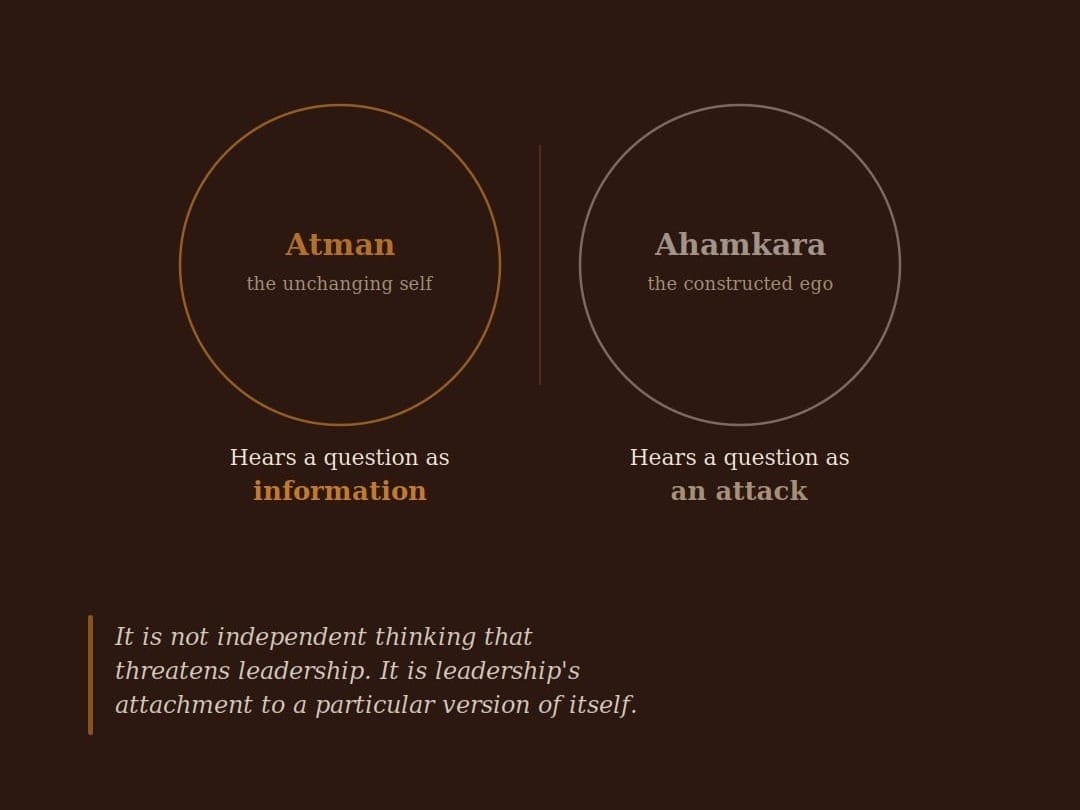
The Gita gives us a useful way to see this: it distinguishes between atman (your true self) and ahamkara (your ego, or who you think you are). We react badly when we confuse our ego with our real self, when being right or in control feels like part of who we are. A leader stuck in ego hears questions as attacks. A leader who’s grounded in their true self just sees information for what it is.
This is the real fault line. It is not independent thinking that threatens leadership. It is leadership's attachment to a particular version of itself.
The Employee Who Speaks Up
The Gita has a parallel teaching for the employee: Nishkama Karma, action without attachment to the fruits of that action. Speak the truth as you see it, with full commitment to speaking it well. Release your attachment to how it is received. That is exactly what carried me through the Partner A conversation: the reasoning was offered in full faith, and once the call was made, the energy moved toward understanding rather than resistance.
What Leaders Have to Do
Just because a question makes you uncomfortable doesn’t mean it’s a bad question. Before calling pushback resistance, a leader needs to separate the actual feedback from what it threatens in them, as Krishna did for Arjuna. That’s not weakness; that’s real strength.
The organizations that survive change and competition aren’t the ones where everyone always agrees. They’re the ones where disagreement is voiced early, while it can still make a difference.