
What I learned about resilience through art
For three months, I sat inside a large, empty, expensive gallery that had nothing in it. We rented the space in October, during the third COVID wave. The idea was simple: start with a solo show in November and see what happened next. But the lockdowns didn’t end as planned. November passed, then December, then January. Each morning, I walked in, turned on the lights, and sat in the quiet, wondering if we had made a mistake.
The truth is, my husband Sudhir and I never planned to open a gallery. I just needed a place to paint. Anyone who’s tried to work creatively at home knows how hard it is with constant interruptions and chores. I wanted a studio with a door I could close. Sudhir listened and said, "You know what, why don't we just make it a gallery?" So we did. And then we sat in it, waiting, wondering.
Before There Was A Gallery
I’ve painted most of my life, though I never went to art school or got a diploma. No one told me I could do this. Wherever Sudhir’s job took us, Bengaluru, Mumbai, Ahmedabad, I kept painting. I taught art classes in every city for kids, women, or anyone interested. At home, we joked that my paintings never piled up because I gave them away to friends moving into new homes. Gathering enough work for a show took patience.
During the COVID period, before we had the gallery, I began teaching online art classes for children from less privileged backgrounds. These kids struggled with textbooks and exams, but they always joined the sessions. They tried new things and got fully involved. For that hour, they disregarded the outside world and just created. At that time, that meant a lot.
The Moment I Understood
When restrictions eased and I held my first show, people came, looked at the art, and shared kind words. Even after years of showing my work in different cities, real reactions from people surprise me. They matter. It felt like passing a test I wasn’t sure I could handle.
But the moment that told me why I'd opened the gallery in the first place came later that year.
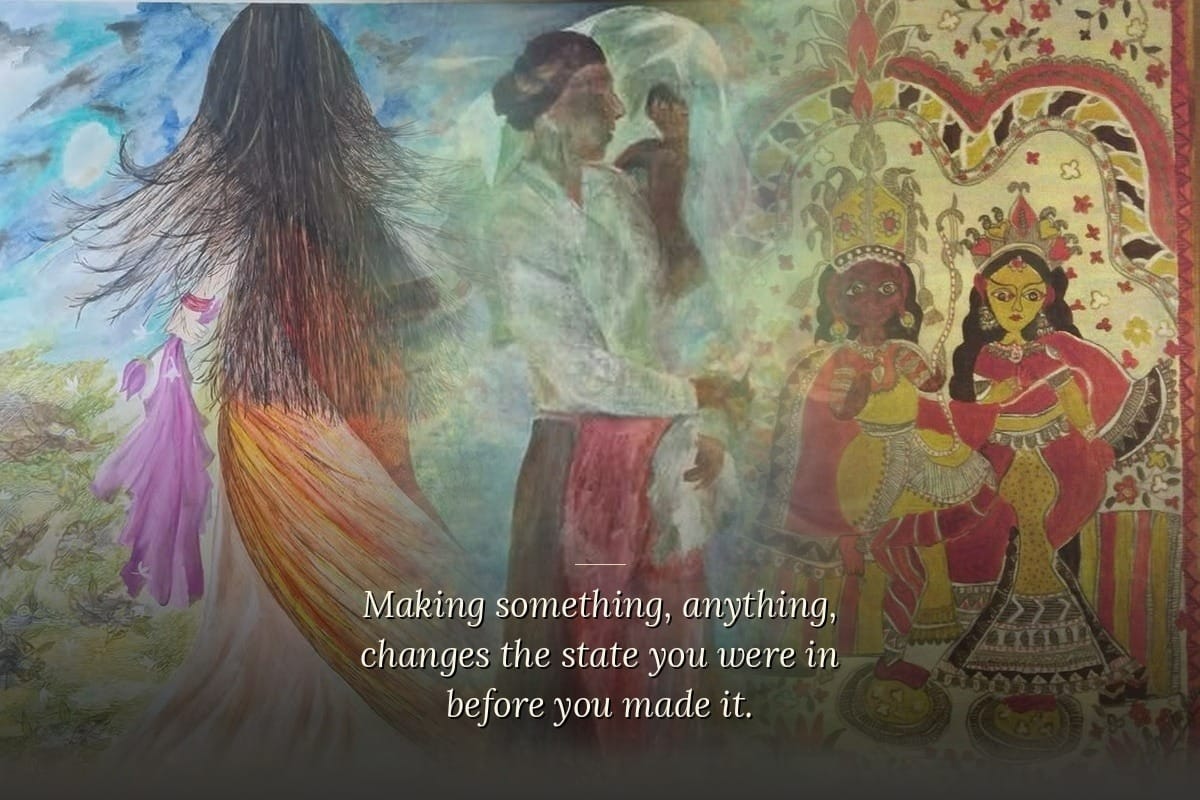
A painting I made years ago hung on the wall, a mother holding her newborn wrapped in a towel. I hadn’t planned to paint it. I made it when I was pregnant with my second daughter. My older daughter was four, Sudhir was working long hours, and I was handling everything at home. One afternoon, I picked up my brushes and painted. When I finished, I felt lighter.
Years went by. The painting stayed in the gallery. Then one day, a woman came in, saw it, and bought it for her daughter, who was expecting a baby. It was a way to welcome new life and to say, I understand what you’re about to feel.
A painting made in my own overwhelm, sitting on a wall for years, then moving into another family's story entirely. That is what art does when you let it. It carries something from one person's unspoken feeling into another's, across years and circumstances neither of them could have predicted.
That realization led me to create Sip & Shades, a workshop series for people in the corporate world. I wanted to share this with others, especially those who might not think of themselves as creative but still carry the burden of stress. In a world where pressure has become a persistent part of work and life, I came to see art not just as an expression but as a form of recovery.
I had seen how stress affects people in those workplaces for a long time. It’s not always dramatic burnout, but a steady, constant pressure with no real break. I kept thinking that art could help here.
There is research to support this. A 2016 study by Girija Kaimal and her team at Drexel University found that just 45 minutes of art-making lowered cortisol, the main stress hormone, in 75% of participants, regardless of artistic experience. That mattered to me because it confirmed what I had been seeing firsthand: you do not have to be an artist to benefit from creating.
I found that fascinating and, honestly, a little validating. But I'd also learned from meeting people in corporate settings that the moment you mention painting, they step back. "That's not for me. I'm not creative. I can't draw." So I started being more direct: please come anyway. Just try it once.
Amul was the first company to try it. They opened a hall at their plant and invited employees from different departments. I brought all the supplies: canvases, easels, paints, and aprons. We painted together, step by step, with music, drinks, and snacks.
What struck me, every time, was watching people who came in convinced they couldn't do it, and then, an hour later, standing a little straighter, proud of something they'd made with their own hands. The stress they'd carried had dissolved into the paint.
What A Simple Act Of Making Can Do
A brush and an hour of music seem like a small thing. I know that.
But I opened a gallery during a lockdown and sat in its quiet for three months before anything happened. What I learned during that silence was the same lesson I learned the day I painted a mother and child alone: making something, anything, changes how you feel.
You don’t have to be an artist for this to help. I’ve seen it work for a struggling child, an overwhelmed mother, and a room full of professionals who just needed a moment to catch their breath.
You just need to be willing to begin. In a stressful world, that small act of making can be powerful.