
What Years Inside the Industry Taught Me About Leadership
There are lessons you cannot learn in a classroom. There are lessons no leadership seminar can teach you. And there are realities you will never fully understand from a boardroom, a spreadsheet, or an executive office.
You learn them in real time while standing beside a frightened resident or listening to a caregiver who has just finished another 12-hour shift or dealing with a family member who asks, "Why isn't my mother getting the care she deserves?" You realize that the people closest to the work often understand the problems long before the people making the decisions ever see them.
After years as a nurse working within assisted living communities, and later transitioning from nurse to business owner, I have learned that the greatest challenges facing assisted living are not simply staffing problems, financial problems, or regulatory problems. They are human problems. And when human problems are ignored long enough, they become organizational problems.
The Reality Behind the Doors
Assisted living was created to provide something many older adults need: safety, dignity, companionship, and support while preserving as much independence as possible.
But somewhere along the way, parts of the industry became increasingly focused on occupancy, budgets, productivity, documentation, and operational targets. Those things matter. But they cannot become more important than the people they are supposed to serve.
When financial pressure becomes the primary lens through which decisions are made, residents begin to feel like numbers. Families feel like revenue sources. Employees feel like replaceable labor. Staff members enter this profession because they care. Yet many eventually experience exhaustion, frustration, moral distress, and burnout. They may know exactly what a resident needs but lack the time, staffing, resources, or authority to provide it.
Imagine caring deeply about someone and repeatedly being placed where you cannot give them the care you know they deserve. That takes a psychological and emotional toll. And everyone downstream feels it, residents notice when caregivers are rushed, when staff turnover is constant, when their concerns seem to disappear into a chain of command. Families notice, too.
The damage is visible to everyone except, often, the people with the authority to address it.
What Happens When Leadership Cannot See What Frontline Staff See
One of the greatest leadership lessons assisted living taught me is this: distance changes perspective.
The farther leadership gets from the frontline, the easier it becomes to believe that reports tell the entire story. They do not. A report can tell you how many residents are in a building. It cannot tell you which resident cried today. A staffing report can tell you how many people were scheduled. A financial statement can tell you what was spent. It cannot tell you what happens when employees become so overwhelmed that they stop believing anyone is listening.
Frontline employees see the gaps between policy and reality. They know when a change will improve care and when it will create another burden. Yet the people closest to residents have the least influence over the decisions affecting them. That is a structural failure, and when it goes unaddressed long enough, it becomes something worse.
When Management Becomes Manipulation
There is a difference between leadership that cannot see the problems and a culture that does not want to. Healthy leadership creates trust. Unhealthy leadership creates fear. When employees believe speaking honestly could cost them their hours, position, reputation, or job, silence becomes a survival strategy.
When families are given carefully orchestrated information, trust begins to erode. When concerns are minimized, redirected, or buried under layers of management, families feel powerless. This is about recognizing what happens when organizational culture rewards protecting the organization instead of confronting the problem.
Good leaders should never be afraid of bad news. Bad news is information. Information gives us the opportunity to fix something before it becomes a crisis.
I saw both sides of this dynamic, first as a nurse navigating it, and later as a business owner responsible for creating something different.
What Becoming a Business Owner Taught Me
Moving from nursing into business ownership changed the way I understood leadership. As a nurse, I experienced the reality on the frontline. As a business owner, I began to understand the decisions happening behind the scenes: the financial pressures, operational responsibilities, staffing challenges, compliance requirements, and difficult choices that leaders carry.
The transition taught me that the frontline and the leadership office are not supposed to be opposing sides. They are supposed to be connected. Every leadership decision eventually reaches a resident and a caregiver.
I carry one moment with me. A resident once told me, "It's always the good ones that leave. No one listens like you do. No one takes the time to talk like you do. No one does the special details in a room like you do, leaving a small bag of chips or chocolate on a pillow after making the bed with fresh linen. You're always upbeat with a smile on your face, and I can tell you love your job or you would not be here."
That is why the work is worth it. Transforming a life, offering hope and purpose, as a nurse, that is more meaningful than money itself. And that understanding, earned on both sides of the divide, shaped how I see the industry's future.
The Industry Is Changing
Assisted living is entering a new era. Technology is changing how communities operate. Families expect greater transparency. Residents and their families are more informed. Workforce expectations are shifting. Financial pressures are increasing. At the same time, the population needing supportive care continues to grow.
The old model of simply filling beds and managing operations will not be enough. The future belongs to organizations willing to ask harder questions: Are our employees thriving? Are residents truly being heard? Do families trust us? Are our financial decisions sustainable without sacrificing human dignity? Do our leaders understand what happens on the floor?
These questions are not weakness. They are leadership.
What I Carry Forward
I believe the future of assisted living must be built around a stronger connection between people, purpose, and responsible business practices. We need leaders who regularly walk the floors, not for inspections, but for understanding. We need systems that allow frontline employees to speak without fear. We need families treated as partners rather than problems. We need residents treated as human beings rather than occupancy numbers.
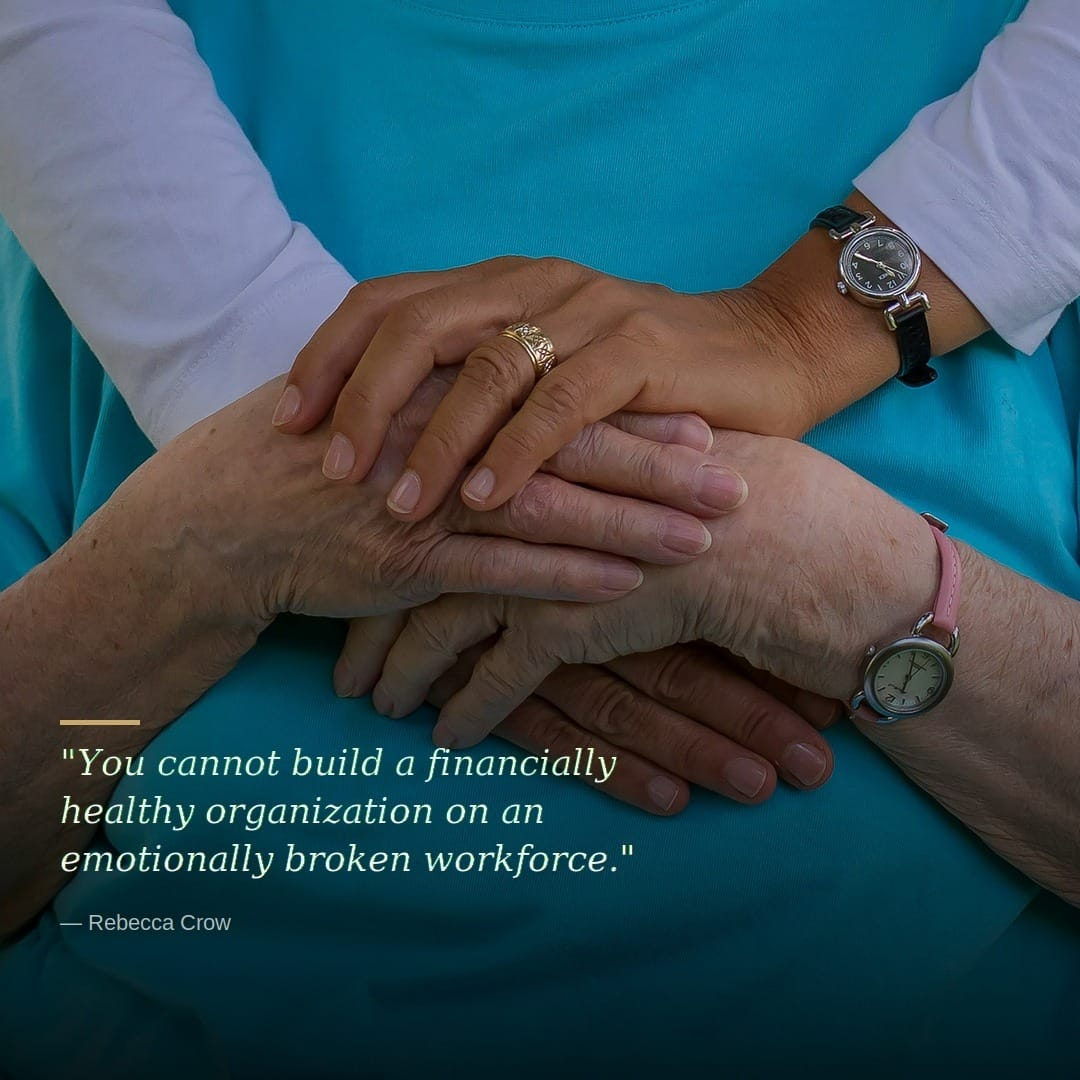
You cannot build a financially healthy organization on an emotionally broken workforce. The answer is not simply hiring more people. It is building cultures where people want to stay. It is not simply creating more policies. It is creating accountability when policies are not working. It is not simply asking employees to care more. It is creating conditions that allow them to care well.
My journey from nurse to business owner gave me a different lens, but my commitment has remained the same: people matter. The assisted living industry does not need more silence. It needs courageous conversations, frontline voices at the table, and leaders willing to remember why these communities exist in the first place.
To care for people. That is the work. That is the responsibility. And that is the future worth building.